
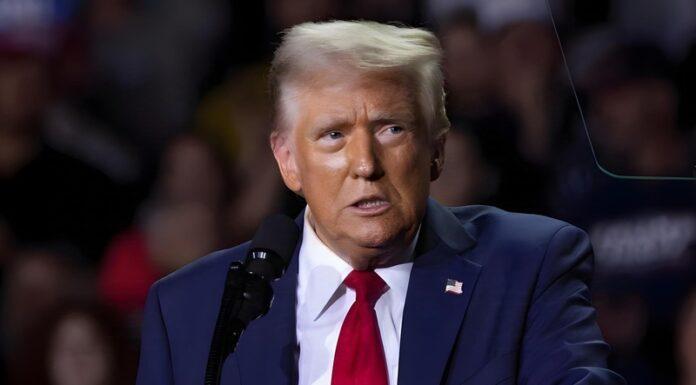
President Donald Trump posted a chart on Thursday, July 2, 2026, that accused NATO members of freeloading on American defense spending, but the graphic fundamentally misrepresents how the transatlantic alliance is actually funded.
The chart Trump shared in two separate Truth Social posts showed the United States contributing $999 billion, followed by the United Kingdom at $90.5 billion, France at $66.5 billion, Italy at $48.8 billion, and Poland at $44.3 billion, with Germany lagging even further behind. But those numbers represent each country’s total national military budget, not payments into NATO’s shared accounts. The alliance’s common budget, which covers headquarters operations and certain joint military and civilian expenses, totals only a few billion dollars per year, with America’s share standing at roughly 22 percent.
The $999 billion Trump attributed to the United States appears to match the defense budget he requested for 2026 under his One Big Beautiful Bill Act, a sum that covers America’s sprawling global military footprint far beyond Europe. Similarly, the United Kingdom’s $90.5 billion, France’s $66.5 billion, Italy’s $48.8 billion, and Poland’s $44.3 billion reflect their entire defense expenditures, not contributions to NATO itself. According to the alliance, defense expenditure consists of funds a national government allocates to maintain its military forces, support its partners, or contribute to collective operations. Because these figures measure fundamentally different things, the comparison cannot support claims about relative burden-sharing within NATO.
Two Posts, One Message
Trump’s grievances stretched across nearly the entire day. At 8:01 a.m. ET, he opened with a morning Truth Social post listing defense spending figures by country and denouncing the disparity as “Ridiculous!” Just before 11 p.m. ET, he returned to deliver a second, sharper attack. Trump wrote, “Ridiculous for the U.S.A. to continue along this one sided path when the relationship is not reciprocal. They were not there for us!!!” Both messages featured the same misleading graph.
Frustration Over Iran War Response
Underlying Trump’s spending complaints is a deeper frustration over the war in Iran, which he launched without congressional approval and to which most NATO allies declined to contribute. During a meeting with NATO Secretary General Mark Rutte last month, Trump said the alliance had let the United States down even though American forces had demolished Iran within the first week of the conflict, according to his account. In the early weeks of fighting, Italy refused to permit American bombers to use its military bases for transit to the Middle East, and Spain closed its airspace to U.S. planes involved in strikes on Iran. Secretary of State Marco Rubio said in May that the president’s disappointment over allied responses to Middle East operations was well documented and would need to be addressed at the upcoming Ankara summit.
Ankara Summit Looms
Thursday’s outburst came days before NATO heads of state convene in Ankara on July 7 for a summit that Secretary of State Marco Rubio said could be tense. The meeting already carries significant baggage. At a NATO summit in The Hague in June 2025, all member states except Spain committed to dedicating five percent of their economic output to defense and security by 2035, with at least 3.5 percent directed toward core military needs — a dramatic escalation from the two percent target that NATO members first agreed to pursue in 2014. Trump celebrated that agreement as a major American victory, but the alliance’s reluctance to follow his lead into Iran has clearly sharpened his grievances since The Hague summit.
Trump’s habit of blurring the distinction between national defense budgets and direct NATO contributions is not new. For years, he has overstated America’s financial burden within the alliance, at various points claiming the United States shoulders as much as 90 percent of NATO’s costs — a figure that does not withstand scrutiny. The U.S. military budget comprises roughly 70 percent of the combined defense spending of all NATO nations, a proportion driven largely by America’s worldwide commitments rather than its European obligations alone. That context has done little to temper Trump’s rhetoric, and Thursday’s double-barreled social media offensive suggests it is unlikely to before the Ankara summit.
