
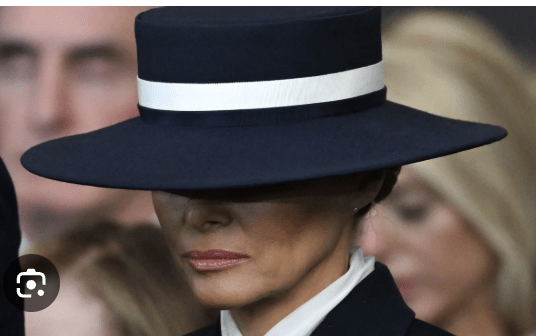
First Lady Melania Trump did not accompany her husband on his three-day state visit to China this week, marking the latest in a string of high-profile diplomatic absences that have set her apart from recent predecessors and raised eyebrows across Washington.
Her spokesperson confirmed hours before Air Force One departed Edwards Air Force Base on Wednesday, May 13, 2026, that “First Lady Melania Trump is not travelling this time.” No additional details were provided, and her office did not immediately respond to follow-up questions about her absence.
A source close to the trip offered only that “The First Lady has prioritised America’s families and children in her initiatives here at home and is focused on these responsibilities at the present time.”
A Pattern Hard to Ignore
Over nearly 16 months of President Trump’s second term, the first lady has attended just one of five formal outbound state visits — a September 2025 trip to Windsor Castle, where King Charles III hosted carriage processions and a banquet in St. George’s Hall. She bypassed Riyadh in May 2025, Doha the following day, and the United Arab Emirates the day after that. Her attendance rate now sits below 20%. During Trump’s first term, she went six-for-six.
The contrast with her predecessors is stark. Laura Bush went two-for-two on George W. Bush’s formal outbound state visits. Jill Biden missed only one — Vietnam in September 2023 — and only because she had tested positive for COVID-19. Even Michelle Obama, who passed on three of her husband’s six state visits over eight years, finished at 50%.
The Beijing absence comes a month after the first lady stunned the West Wing by calling a surprise press conference to declare she had no ties to the late sex trafficker Jeffrey Epstein — a statement that resurrected a scandal her husband had been laboring to bury. On Fox News on Wednesday, April 13, host Brian Kilmeade narrated footage of a woman descending the steps of Air Force One by announcing, “As the first lady comes down the stairs to greet the president.” Co-host Ainsley Earhardt quickly corrected him.
Stranger still: the man who produced Melania Trump’s critically panned documentary last year did make the trip. Brett Ratner, the “Rush Hour” director whose film franchise is reportedly among the president’s favorites, boarded Air Force One to scout locations for a fourth installment. The Melania documentary, acquired by Amazon for $40 million, was Ratner’s first significant project since 2017, when several women accused him of sexual misconduct. He denied the claims.
The president traveled with cabinet secretaries, 16 corporate chief executives, his son Eric and daughter-in-law Lara — and one conspicuous absence. Melania Trump, who joined her husband for his triumphant November 2017 visit to China, stayed home.
Pageantry at the Great Hall
Xi Jinping went to extraordinary lengths to roll out the red carpet. A military honor guard lined up outside the Great Hall of the People with a gun salute and a band playing both national anthems. Schoolchildren waved Chinese and American flags as Trump paused twice to greet them. The president toured the 15th-century Temple of Heaven, called the visit a “cherished” opportunity at the state banquet, and lavished praise on his host. “You’re a great leader. I say it to everybody,” Trump told Xi.
Behind closed doors for two hours, however, the warmth cooled. Chinese Foreign Ministry spokesperson Mao Ning posted that Xi had told Trump “the Taiwan question is the most important issue in China-U.S. relations,” warning that mishandling it could put “the entire relationship in great jeopardy.” Secretary of State Marco Rubio, traveling with the president, said afterward that U.S. policy on Taiwan remained “unchanged” but cautioned that any attempt by Beijing to take the island by force would be “a terrible mistake.”
Iran, Tariffs, and Rare Earths
The Iran war loomed over the talks. China is Tehran’s largest trading partner, and a blocked Strait of Hormuz has rattled the global economy. Just before 6 a.m. Friday, May 15, in Beijing — 6 p.m. ET Thursday, May 14 — Trump told Sean Hannity that Xi had pledged not to provide military equipment to Iran and signaled he “would like to be of help” in brokering a resolution. Asked about his own stalled campaign against Tehran, Trump replied that it was “to be continued!”
The economic stakes are equally vast. China manufactures roughly a third of the world’s goods, processes more than 90% of rare earth minerals, and produces between 60% and 80% of all solar panels, wind turbines, and electric vehicles. Tariffs between the two countries crossed 100% at the height of last year’s trade war before a fragile truce took hold.
“We are witnessing a historical change,” said John Delury, a senior fellow at the Asia Society’s Center on US-China Relations. “I hesitate to put too much on this specific summit, but the inexorable rise of China to a place where it is legitimately rivalling the U.S. — that is now happening before our eyes. Beijing is asserting itself as a true rival to Washington on the world stage.”
Xi is scheduled to make a reciprocal visit to the White House on Sept. 24, just weeks before the November midterm elections. Whether the first lady will appear at his side remains, like so much about her current role, an open question.
