
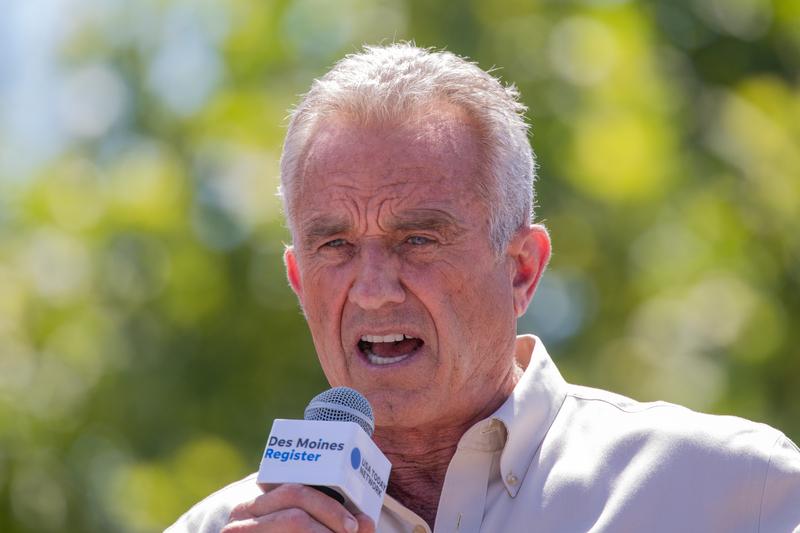
A budget dinner from Health and Human Services Secretary Robert F. Kennedy Jr.’s new cooking series went to a checkout counter on Wednesday’s edition of “Erin Burnett OutFront” and rang up at roughly 3.6 times the figure he had promoted. One night later, on Thursday night, August 20, 2026, Kennedy hit back at CNN anchor Erin Burnett in a lengthy post on X.
The dish in question — wild Alaskan salmon cakes with a white bean and green salad — is listed on Kennedy’s YouTube program “The Real Food Show” at $19.64 to feed a family of four, or about $4.91 per person. Tom Foreman, a CNN correspondent, bought the same ingredients at a neighborhood supermarket and cooked the same meal. His register hit $70.54.
Kennedy, 72, was not amused. “Trump Derangement Syndrome has so debilitated @ErinBurnett that she has abandoned both common sense and basic arithmetic,” he wrote. The network, by his account, expected the show to add up the full package price of each ingredient no matter how little of it a recipe actually calls for. A diner who squirts ketchup once on a burger, he asked, does not get handed a bill for the whole bottle, does he?
How the $5 Math Works
Bookkeeping explains the gap between the two totals. Per-serving figures on the show cover only the share of each ingredient a recipe calls for — not the sticker price of the package a shopper has to carry to the register. The method is the standard one for costing out recipes, a point Foreman conceded; the logic, he said, collapses as soon as you set foot in a supermarket.
“They’re only pricing parts of it, and grocery stores don’t sell things that way,” Foreman said.
Line by line, the receipt makes the case. Wild-caught sockeye salmon appears on the program at $8.99. The cheapest fish of that kind on the shelves came to $24.04 when Foreman scanned it — and that figure was already discounted. Red onion was another example: 8 cents was the number attached to a serving, while the onion itself cost $1.03. Avocado mayonnaise was counted as 40 cents; the jar it had to be spooned from cost $11.19. How anyone carries $20 into a store and walks out with every item the recipe demands was something Foreman said he could not work out.
To Kennedy, the leftovers are the whole idea. Kitchens, he says, are something he wants Americans to reclaim, with shelves stocked with quality staples that can stretch across many meals. Replies on X were not convinced: no supermarket sells ketchup by the squirt, they noted, and sockeye salmon is hardly a pantry item that keeps.
A Second Price Check, Same Result
Others were running the numbers, too. The online cart of the grocery store nearest her was where Monica Hesse, a Washington Post columnist, entered Kennedy’s ingredient list, choosing the least expensive option at every turn. Her total came to $73.46, a little over $18 per serving — close to four times what the show claimed.
From Dietary Guidelines to YouTube
The series premiered on July 30, with Kennedy traveling the country to cook alongside guest chefs. Healthy meals for under $5 a serving “whenever possible” were what his department said viewers would learn to put together. In the opening installment, Kennedy cooked with chef Andrew Gruel on “Crispy Salmon Cakes with Apple, White Bean & Green Salad” — the very dish now being scrutinized. Chef Robert Irvine was also slated for the early episodes.
As a complement to the Dietary Guidelines for Americans released in January 2026, the show follows guidance that puts protein at the center of every meal and emphasizes full-fat dairy, vegetables, fruits and whole grains under the banner “Eat Real Food.” Before the premiere, Kennedy sat down in Washington with USA TODAY for an exclusive interview. Critics who argue the guidelines cost more than ultra-processed food are flatly mistaken, he said, pointing out that a fast-food meal now runs $12 to $14 and that a family can eat both better and cheaper at home. Cooking is a skill many Americans have lost, he said, and reacquainting them with it is part of his department’s job. Regular home cooking was reported by more than half of men and close to three-quarters of women in a 2023 study published in the journal Current Developments in Nutrition.
Kennedy is a devoted booster of fermented food who never travels without a supply of sauerkraut, and restaurants were once where he brought his own stash, he told the paper, until the objections mounted. The show’s recipes feature kimchi, sauerkraut and yogurt. Eggs, bacon, burgers, steaks and fish make up most of the two meals a day he cooks, and the stronger cook in the household, he says, is his wife, actress Cheryl Hines. Chronic childhood disease is the target his Make America Healthy Again (MAHA) movement claims for itself, a campaign aimed at environmental toxins, ultra-processed food and what he calls overmedicalization.
Not the Only Cabinet Camera Crew
Other Trump administration officials have chased a streaming audience this summer as well. On the same Wednesday CNN ran its price check, Transportation Secretary Sean Duffy rolled out “The Great American Road Trip.” The YouTube series chronicles a cross-country trip lasting seven months, taken with his nine children and his wife, Rachel Campos-Duffy. Accusations of “gift laundering” followed, since sponsors including Toyota and United Airlines fall under his department’s oversight.
