
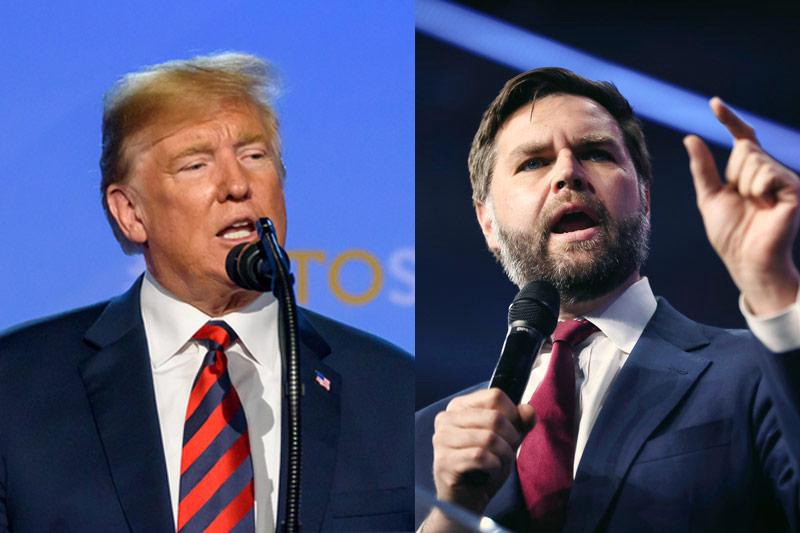
Vice President JD Vance now finds himself at the center of competing forces within Republican circles, facing internal party attacks that his supporters describe as coordinated, while President Donald Trump has recently signaled he views the 41-year-old as his chosen successor for 2028, according to fresh reports and analysis from Trump biographer Michael Wolff.
Trump has shifted his stance from viewing Vance and Secretary of State Marco Rubio as competing potential heirs to openly backing his vice president, with one senior administration official telling reporters, “It’s become, ‘JD’s our guy, we gotta help JD.'” The president’s change of heart reportedly came after observing how Vance conducted himself during a recent book tour for his new memoir “Communion: Finding My Way Back to Faith,” where Trump was impressed by his vice president’s ease across multiple media appearances.
But that presidential confidence comes as Vance weathers mounting criticism from Republican quarters. Wall Street Journal columnist Kimberly Strassel recently called Vance a “sensitive bunny” after his staffers contacted her editors to complain about a column critical of the vice president. Vance’s allies characterize the online assaults as a deliberate political campaign to weaken him as he weighs his presidential ambitions.
Distance From the White House
On the Daily Beast’s “Inside Trump’s Head” podcast, released Tuesday, July 21, Wolff painted Vance as the clearest example of a Republican already creating separation from the 80-year-old president. Wolff told co-host Joanna Coles that Vance isn’t simply hedging his bets but deliberately distancing himself as the next White House race begins to crystallize.
Wolff pointed to Vance’s recent appearance on podcaster Joe Rogan’s program, where the vice president acknowledged the administration had been “guilty” of fumbling its handling of the Jeffrey Epstein files scandal, a rare public break from a White House still struggling with that controversy.
The author described it as Vance “basically publicly proclaiming his distance from Donald Trump” and suggested other serious contenders for 2028 will follow the same playbook, whether openly or not. Wolff drew a contrast to former Vice President Kamala Harris, who in 2024 resisted advisers urging her to separate herself from then-President Joe Biden after he dropped his reelection campaign. Vance, Wolff argued, is making the opposite choice and starting much earlier.
A President Under Dual Pressure
Trump confronts a pair of hostile realities as the November midterms approach, Wolff explained. Democrats are poised to retake the House, a development Wolff predicted would transform the legislative branch into a relentless torment for the administration.
Congress will become “an incredible noose around his neck, a burden on his shoulders,” he said, warning that Democrats intend to obstruct and embarrass Trump whenever possible, though he noted such strategies have sometimes boomeranged in the past.
The more unexpected challenge, according to Wolff, stems from Trump’s own coalition. He cited Republican resistance to the Save America Act, legislation the president championed, as proof that party members no longer automatically comply with his demands, though the House of Representatives ultimately passed the bill on July 22.
Wolff characterized the dispute as symptomatic of a larger pullback. Republicans are drifting “further and further away from him,” Wolff said, a process already in motion. Lawmakers kept insisting they couldn’t deliver the legislation, he noted, which he interpreted as a direct rejection no matter the official explanations.
That assessment arrived amid visible frustration among Trump supporters over Congress departing for recess without advancing the president’s agenda, the sort of friction that typically intensifies as a presidency winds down.
The Incentives to Break Away
Wolff maintained that the electoral arithmetic offers every aspiring Republican candidate a clear reason to maintain separation. He referenced Trump’s 37 percent approval rating, combined with voter dissatisfaction over his stewardship of the economy and the Iran conflict, as circumstances that transform allegiance into a political handicap for anyone eyeing the next campaign.
Trump has privately complimented Vance’s weight loss, which the vice president attributes to a sauerkraut-heavy diet now popular among several administration officials, fresh reporting indicates.
The administration has made its disdain for the author abundantly clear. White House Communications Director Steven Cheung has in the past called Wolff a fraud and accused him of inventing narratives, rhetoric the White House has consistently employed to counter his work.
That animosity dates back years. Wolff first enraged the administration with “Fire and Fury: Inside the Trump White House,” his 2018 book in which staffers reportedly compared the president to a child. Wolff told PBS News during that period that aides characterized Trump as someone who “does not read, does not listen” and said those nearest to the president were “afraid” for both their professional futures and the nation’s well-being.
Then-White House press secretary Sarah Sanders condemned the book as “trashy tabloid fiction,” while Trump’s attorney Charles Harder sought to block its release. It became a bestseller regardless. Before focusing on Trump, Wolff contributed to New York magazine and Vanity Fair and authored a 2008 biography of media mogul Rupert Murdoch titled “The Man Who Owns the News.”
Whether Wolff’s projections prove accurate or amount to speculation, as the White House insists, the fundamental dynamics he identifies are undeniable. A chief executive entering his final phase, an opposition ready to capitalize and an ambitious number two charting his own course constitute pressures that don’t require a chronicler to exist.
New episodes of the podcast, co-hosted by Wolff and Coles, appear on YouTube each Tuesday, Thursday and Saturday night, while other podcast platforms carry them on Wednesday, Friday and Sunday mornings.
