
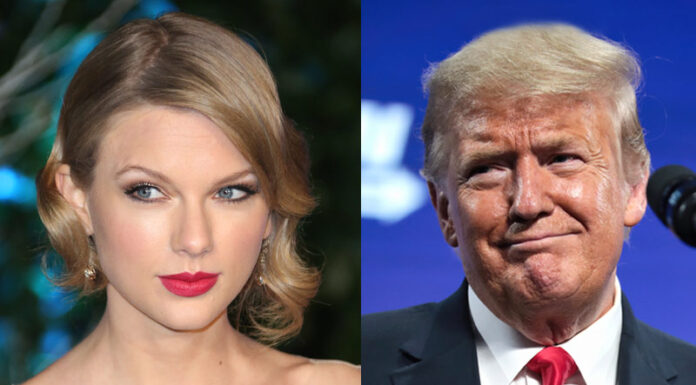
President Donald Trump’s rocky relationship with public reception reached another low point on June 8, 2026, when the sitting president attended Game three of the NBA Finals at Madison Square Garden and was greeted with loud boos from the crowd. The jeers came as Trump appeared on the jumbotron giving a military salute during the national anthem, making him the first sitting president to attend an NBA Finals game.
Just two days later, on June 10, 2026, Taylor Swift showed up at the same venue for Game four wearing a custom “Stevie Knicks” shirt and was met with thunderous applause when her face flashed across the arena’s screens. The pop superstar, there to support fiancé Travis Kelce, received the kind of warm welcome that has consistently eluded Trump in the very cultural spaces he seeks to dominate.
The stark difference between the two receptions was impossible to miss — and painfully familiar.
Earlier this year at Super Bowl LIX, an almost identical scene played out. Trump showed up and drew boos, while Swift, cheering on Kelce, was celebrated by the crowd with the enthusiasm reserved for someone at the peak of their cultural influence. Madison Square Garden simply delivered a sequel on one of the biggest stages in New York sports history.
When Trump appeared on screen during the national anthem at Game three, the arena’s “U-S-A! U-S-A!” chants quickly dissolved into jeers. The boos lasted only seconds, ending when the U.S. flag replaced Trump’s image on the jumbotron. The crowd erupted once more when Knicks players were shown instead.
Trump’s version of events differed sharply from what observers witnessed. “It was, I think, mostly cheers,” Trump told reporters after the game before boarding Air Force One to return to Washington. “It was loud, and it was very enthusiastic.”
Swift’s appearance two days later caused none of the logistical chaos that accompanied the president’s arrival. Trump’s presence had triggered hours of delays due to heightened security and Secret Service protocol leading up to tip-off, grinding the arena to a near-standstill. Swift’s arrival, by contrast, didn’t significantly impact fans’ arrival times and brought nothing but noise and goodwill.
The president has never quietly accepted his troubled dynamic with Swift. In the days surrounding the NBA Finals games, Trump took to Truth Social with yet another unprovoked attack, claiming she was “no longer hot” since he had declared he hated her. The remark generated widespread mockery and served as another reminder of Trump’s long and one-sided fixation with the singer.
Their feud has been simmering since at least 2024, when Swift endorsed Kamala Harris for president and Trump responded with a series of increasingly personal attacks. The tension has never fully cooled. In April 2026, The Mirror reported that Swift’s upcoming wedding to Kelce — reportedly planned for July 3, 2026, at Madison Square Garden — was likely to anger Trump due to the date, which coincides with America’s 250th anniversary celebrations. The report added yet another layer to a conflict that has now stretched across two presidential campaigns and multiple sporting events.
Kelce’s position in this ongoing drama adds its own complexity. While Swift and Trump have remained at public odds, Kelce himself was spotted at a golf event chatting with Trump’s granddaughter Kai Trump, who had also attended Game three at MSG alongside the president. The images went viral, prompting speculation about how the two camps navigate the tension between their respective associations with one of the most polarizing figures in American public life.
The wedding planning has become a story in its own right. Sources have reported that guests are being required to sign non-disclosure agreements, and the couple has been photographed together at various public events as the July date approaches. The spectacle of Swift potentially marrying Kelce at the same arena where Trump was booed — and where she was cheered just days later — has not been lost on commentators.
For Trump, the Madison Square Garden episode was more than an embarrassing night at a basketball game. It was a reminder that in the cultural spaces he most wants to occupy — sports arenas, entertainment, the mainstream of American popular life — he remains a figure who divides rooms rather than unites them. And that in those same spaces, Taylor Swift continues to be everything he is not: universally welcomed, warmly received, and entirely unbothered.
The contrast could not have been more stark — or more familiar. The story, as always with these two, will last considerably longer.
