
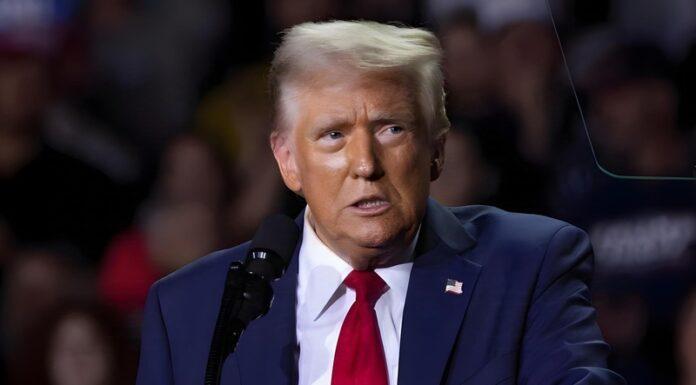
A redistricting battle in Virginia has erupted into a multi-front legal war that could reshape the balance of power in Congress, with President Trump inserting himself into the controversy by claiming he’s too smart to understand the ballot question voters just approved.
Virginia voters on April 21, 2026, backed a referendum allowing the state’s Democratic-led General Assembly to redraw congressional district lines mid-decade. The measure won 51.5 percent to 48.5 percent, with 1,575,288 voters supporting the change. If the new map takes effect, Democrats could control 10 of Virginia’s 11 congressional districts, up from their current 6-to-5 advantage in the U.S. House delegation.
The victory came despite Trump’s complaints about the wording. “As everyone knows, I am an extraordinarily brilliant person, and even I had no idea what the hell they were talking about in the Referendum, and neither do they!” he wrote on Truth Social the day after the vote. He called the ballot question “purposefully unintelligible and deceptive.”
Legal Battles Freeze the Results
The referendum’s fate now rests with the Virginia Supreme Court. Tazewell County Circuit Court Judge Jack Hurley issued an injunction the day after the vote, blocking certification and ruling the referendum void on procedural grounds. Attorney General Jay Jones vowed to appeal, and the state’s high court heard oral arguments on April 27.
The Supreme Court of Virginia denied Democrats’ request to pause the Tazewell County judge’s ruling, meaning the State Board of Elections cannot move forward with certifying the results of the April 21 redistricting referendum. Certification had originally been scheduled for Friday, May 1.
This ruling addressed only the request for a stay, not the merits of the appeal. The decision keeps the legal pause in effect until the court rules on the full case, which could determine whether the new congressional maps are ever used. No date has been set for that final decision.
During oral arguments, two justices sounded skeptical of Democrats’ arguments, raising questions about the definition of “election” and whether Democrats properly convened when they first tried to advance redistricting ahead of the November 2025 elections.
Multiple ongoing lawsuits complicate the situation. In a third case challenging the map itself—separate from the Tazewell cases—a circuit court rejected GOP claims that the map violated “compactness” requirements stipulating that districts not have overly unusual shapes. That was a win for Democrats on that front.
Among Republican arguments is that the ballot question lacked “neutral framing” because it described the new districts as restoring fairness to the state’s congressional map. Trump signaled support for the legal fight in his post, writing, “Let’s see if the Courts will fix this travesty of ‘Justice.'”
Trump’s Claims of Fraud
On Wednesday, April 22, Trump took to Truth Social to vent his frustration, alleging without evidence that the contest had been stolen. “A RIGGED ELECTION TOOK PLACE LAST NIGHT IN THE GREAT COMMONWEALTH OF VIRGINIA!” he wrote, before pivoting to a now-familiar critique of mail-in voting and accusing Democrats of a late-night ballot drop. No irregularities were reported during the voting, and Virginia law does not permit absentee or mail-in ballots to be counted before 8 p.m. on Election Day—a procedural detail that explains the late shift in totals.
Trump has used mail-in voting himself, a fact absent from his post. He also grumbled about the mathematics, writing that “Six to five goes to ten to one, and yet the Presidential Election in November was very close to a 50-50 split.” That comparison glossed over the fact that he lost Virginia in the 2024 presidential election 16 months ago by 51.82 percent to 46.05 percent—a margin nearly identical to the redistricting result.
Turnout in Democratic Strongholds
Democrats had projected victory based on heavy turnout in Arlington County, Fairfax County, Loudoun County, Prince William County, and Henrico County—all home to large numbers of federal workers affected by the Trump administration’s efforts to slash federal employment rolls. That dynamic, combined with broader frustrations, produced the turnout Democrats needed.
An April 19 NBC News Decision Desk Poll showed Trump’s approval rating at 37%, against 63% disapproval, fueled in part by backlash to the war in Iran. The redistricting vote landed squarely in that climate.
Virginia Gov. Abigail Spanberger, who campaigned for the new map, shifted her attention quickly to November. She said voters had “approved a temporary measure to push back against a president who claims he is ‘entitled’ to more Republican seats in Congress,” adding, “I understand the urgency of winning congressional seats as a check on this President, and I look forward to campaigning with candidates across the Commonwealth working to earn Virginians’ trust.”
A National Redistricting War
Virginia is the latest front in a redistricting arms race Trump kicked off last year by urging Texas Republicans to redraw their congressional map mid-decade. He has since pressured GOP-led legislatures in Missouri, North Carolina, and Ohio to follow suit, and those efforts have so far added as many as nine seats favoring Republicans, according to trackers cited in reporting on the issue.
Democrats have already fired back. California voters approved Proposition 50 in November 2025, creating five additional Democratic-leaning districts, while a court-ordered map in Utah added one more seat likely to favor Democrats. The Virginia outcome could allow Democrats to flip as many as four House seats currently held by Republicans, with the new boundaries in place until the 2030 Census. Princeton University’s Gerrymandering Project had rated Virginia’s existing boundaries as among the fairest in the nation, giving them an “A” grade. Those maps were imposed by the Virginia Supreme Court’s special masters in 2021 after the state’s bipartisan redistricting commission, established by a voter-approved constitutional amendment in 2020, deadlocked.
Republican strategists believe the GOP could still pick up as many as nine new seats nationwide through redistricting in friendly states—and possibly more if Florida redraws its maps in a special session—even as Democrats counter with as many as 10 new favorable districts of their own across California, Virginia, and Utah. With control of the House riding on the outcome, every district line drawn between now and November 2026 is being scrutinized—even the ones a self-described “extraordinarily brilliant” president says he can’t quite figure out.
Bottom line: the redistricting referendum result remains in legal limbo, with the Virginia Supreme Court yet to rule on the full merits of the case.
