
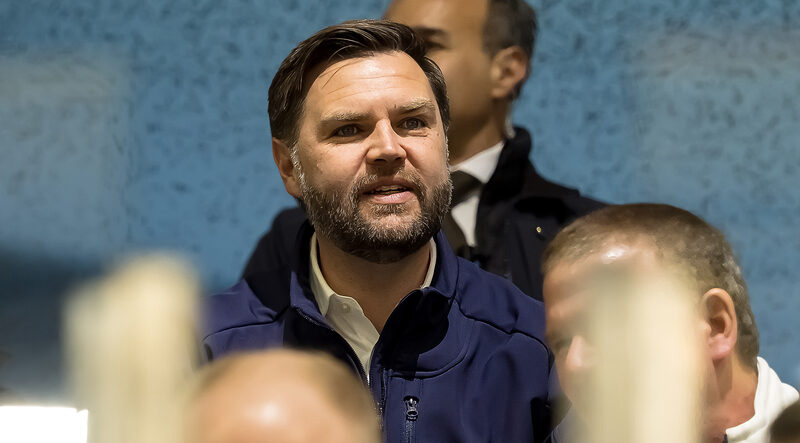
Secretary of State Marco Rubio conducted a confidential discussion with Pope Leo XIV on May 7, 2026, during a Vatican meeting that notably left Vice President JD Vance out of the conversation. The 11:30 a.m. session at the Apostolic Palace demonstrated a significant diplomatic decision that underscored the troubled connection between the Trump administration and the Holy See, along with an escalating rivalry between two prominent Catholic figures in the president’s cabinet.
Rubio’s extended stay in Rome, spanning May 6 through May 8, encompassed meetings with Vatican Secretary of State Pietro Parolin and Italian Prime Minister Giorgia Meloni. The date held weight: the papal audience transpired just 2 days before Pope Leo marked his first anniversary leading the worldwide community of 1.4 billion Catholics.
Trump’s Harsh Criticism Of The Pope
This diplomatic initiative takes place against the backdrop of extraordinary public antagonism between President Trump and the first pontiff born in America. Following Pope Leo’s call for the quieting of Middle Eastern tensions and his rejection of Trump’s declaration to obliterate Iranian civilization as unacceptable, the president responded harshly, labeling Leo “WEAK on crime, and terrible for foreign policy.”
Throughout a May 5 interview on The Hugh Hewitt Show, Trump escalated his remarks, asserting Leo approved of Iran acquiring atomic capabilities and suggesting the pontiff was “putting numerous Catholics and many others in danger.” Pope Leo countered the next day, saying those who challenge him should “do so with the truth,” and explicitly rejected the weapons claim: “The church has spoken out against all nuclear weapons for years, so there is no doubt on that point.”
Trump’s stringent border enforcement measures have prompted further papal objections, intensifying the rift. Faith leaders throughout America and worldwide voiced backing for the pope following the president’s remarks, and a Washington Post-ABC News-Ipsos poll released May 6 showed Trump’s approval among U.S. Catholics had fallen to 38%, a 10-point drop since February 2025, with his support among White Catholics sliding from 63% to 49% — an unwelcome trend for a president who captured Catholic voters in 2024.
Vance Excluded From Papal Discussions
Vance, who converted to Catholicism in 2019, and Rubio had previously encountered the pope together on May 19, 2025, the day following Leo’s inauguration ceremony, rendering the vice president’s exclusion from this occasion remarkably striking. His omission garnered considerable focus in both Washington and Rome. Ahead of the meeting, Vatican Secretary of State Cardinal Pietro Parolin said Trump’s attacks on the pope would be unavoidable subjects of discussion. “I imagine that everything that has happened in these days will be talked about,” Parolin told reporters. “The pope is doing what he must do, the pope is being the pope, so to attack him in this way, to reprimand what he does seems to me a bit strange,” he added.
The exclusion sparked conjecture regarding escalating competition between Rubio and Vance, both ranking administration figures contending for authority. By securing the sought-after Vatican audience while Vance was sidelined, Rubio seemed to have obtained the upper hand in directing the administration’s outreach to Catholics.
What Transpired Inside The Vatican
When the two individuals convened on the morning of May 7, the meeting surpassed projections regarding both span and cordiality. Rubio came with his spouse, Jeanette Dousdebes Rubio, and was welcomed by Pope Leo before the two engaged in private conversation within the pope’s study. The discussion extended considerably beyond the planned window, exceeding 45 minutes of private exchanges, with Rubio occupying over two hours altogether within the Apostolic Palace. Leo referred to Rubio formally as “Mr. Secretary”; Rubio answered, “Great to see you.” The pontiff gave Rubio a pen fashioned from olive timber, “the plant of peace,” he noted, whereas Rubio presented a crystal football bearing the State Department seal, mentioning he understood the Chicago-born pontiff favored “more of a baseball guy.” Vatican representative Matteo Bruni stated the conversation encompassed the Middle East, Iran, Lebanon, Africa, and Cuba.
Meloni Entangled In The Dispute
Rubio’s May 8 afternoon discussion with Meloni, which the secretary personally initiated per an Italian administration representative who communicated with AFP, contributes a further dimension to the diplomatic endeavor. The right-wing Italian administrator, formerly viewed as one of Trump’s most dependable continental compatriots, has experienced that partnership decline substantially following her backing of the pope.
Trump assailed Meloni for demonstrating insufficient resolve after she championed the Catholic leader. The president has additionally suggested pulling American military personnel from Italy, objecting that Rome “has not been of any help to us” regarding the Iran conflict. Italian press organizations have portrayed this period’s diplomatic communications as a bid to “normalize” connections harmed by Trump’s hostile language.
“Discussions with Italian associates will concentrate on mutual defense matters and tactical coordination,” the State Department announced. Following the discussion, Rubio stated that disputes separating governmental figures and the Catholic institution would not obstruct future cooperation. When questioned if he would recommend Trump discontinue criticizing the pope, Rubio stated: “The president will always speak clearly about how he feels about the U.S. and U.S. policy. I think we can do that and continue to have a very productive relationship with the church.”
Cuba And Western Hemisphere Subjects Under Discussion
Cuba held a central place in Holy See discussions. The Holy See performs a significant diplomatic function regarding Cuba, whereas Rubio, of Cuban heritage, has directed the Trump administration’s forceful measures toward Havana’s socialist administration. Holy See delegates have conventionally functioned as quiet go-betweens in American-Cuban diplomatic relations, and the restricted papal gathering furnished a prospect to revive that diplomatic connection.
For the Holy See, interacting meaningfully with Washington regarding worldwide concerns while preventing any semblance of capitulation to a government that has openly humiliated the pontiff and a prominent continental Catholic figure presents an intricate predicament. Holy See observers noted that the Holy See’s declaration, subsequent to the gathering, was markedly subdued, missing the friendlier phrasing customarily featured following effective American-Vatican communications. Former American Vatican diplomat Peter Martin communicated to Reuters the language “makes it clear that, at present, there is work to do,” while Catholic Church specialist Austen Ivereigh indicated the declaration’s emphasis on developing diplomatic ties indicated the institutions are “at the moment not good.” For Rubio, the gathering positioned him as the essential intermediary separating an infuriated commander and a steadfast pontiff, exactly the capacity that numerous observers anticipated Vice President Vance would play.
Whether the May 7 gathering produced an authentic settlement or simply glossed over substantial disagreements remained unclear. After the gathering, the Holy See stated both participants “renewed the shared commitment to fostering good bilateral relations,” suggesting at minimum a modest diplomatic adjustment despite continuing disputes regarding immigration and the Iran situation. On May 9, commemorating his first anniversary as leader of the Catholic institution, Pope Leo petitioned for divine guidance to prompt authorities to reduce hostilities. “We cannot resign ourselves to the images of death that the news shows us every day,” he declared throughout his remarks in the area of Pompeii.
