
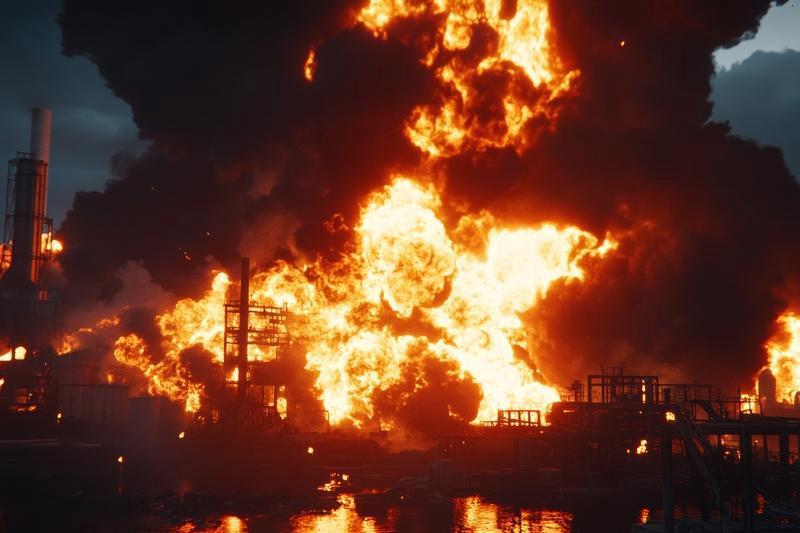
A massive explosion tore through a fireworks factory in central China on May 4, 2026, killing at least 37 people and injuring dozens of others in one of the deadliest industrial accidents to strike the country’s fireworks heartland in years. The blast at the Huasheng Fireworks Manufacturing and Display Co. plant in Liuyang, Hunan province, prompted Chinese President Xi Jinping to order a comprehensive investigation and a regional suspension of fireworks production.
The explosion struck at approximately 4:40 p.m. in the county-level city of Liuyang, a Changsha-administered municipality long regarded as China’s fireworks capital. Authorities detained the person in charge of the company as rescue teams combed through the wreckage, which continued emitting plumes of white smoke until May 5.
Scene Of Widespread Destruction
Aerial footage broadcast by state media on May 5 revealed the scale of the devastation: collapsed and damaged facilities, scorched earth, and lingering smoke drifting across the industrial site. A separate video circulated on social media showed buildings damaged or destroyed across multiple city blocks, underscoring the explosive force of the blast in a city of 1.5 million people.
More than 1,500 firefighters, rescuers, medical personnel, and police were deployed, supported by drones and three robots to assist with search operations and reduce risks to human responders. Crews adopted spraying and humidification measures to neutralize potential hazards, particularly two black powder warehouses near the explosion site that posed the threat of secondary blasts.
Residents in danger zones were evacuated as a precaution. Changsha Mayor Chen Bozhang said that “search and rescue at the scene has largely been completed, but verification of the casualties and identification of the victims are still underway.” The full scale of the incident remains unclear, with the number of missing persons not yet disclosed.
Xi Demands Accountability And Reform
Xi urged ‘all-out efforts’ to locate those still unaccounted for and treat the injured while calling for a swift investigation into the disaster and broader workplace safety reforms nationwide. He ordered effective risk screening and hazard control across key industries, alongside strengthened public safety management.
“Authorities across regions and departments must draw profound lessons from the accident and reinforce responsibility for workplace safety,” Xi said, according to remarks carried by Chinese state media. Both Xi and Premier Li Qiang have called for a far-reaching evaluation of workplace safety measures in the wake of the disaster.
Public security authorities confirmed they had taken measures against the company’s person in charge, with reports suggesting an arrest. On May 7, China’s Supreme People’s Procuratorate announced it is directly supervising the criminal investigation — a significant escalation beyond the State Council inquiry already underway. Reporting by Caixin Global revealed that Huasheng had been fined as recently as February for unsafe chemical mixing and had fraudulently borrowed a safety manager’s credentials — a practice in which a company lists a licensed individual on paper without that person actually working on site.
A Region Built On Fireworks
Liuyang’s prominence in the fireworks trade is staggering: the city produces roughly 70 percent of China’s fireworks exports and accounts for 60 percent of the country’s domestic market. The industry’s roots stretch back more than a millennium.
The Guinness World Records organization credits the first accurately documented firework, the Chinese firecracker, to Li Tian, a monk who lived near Liuyang during China’s Tang dynasty, dating to roughly A.D. 618 to 907. Li discovered that gunpowder packed into hollow bamboo stems produced loud explosions, leading to the traditional New Year firecrackers used to drive away evil spirits.
That deep heritage, however, has been shadowed by repeated tragedies. A 2019 fireworks factory accident in Liuyang killed 13 people and injured 17. Local authorities initially attempted to conceal the extent of that disaster, claiming only seven had died before an investigation by Hunan’s provincial government revealed the higher toll. The pattern of underreporting has fueled public skepticism about official accounts of industrial accidents in the region.
A Pattern Of Deadly Blasts
This week’s catastrophe is not an isolated event. In February, China reported two deadly explosions at fireworks shops around the Lunar New Year period, raising fresh questions about regulatory enforcement in an industry that handles vast quantities of explosive material. The recurrence of such incidents has placed pressure on Beijing to deliver more than rhetorical commitments to workplace safety.
Regional fireworks production was suspended as investigators sought to determine what triggered the May 4 blast. The Huasheng plant, once a small piece of a sprawling industrial network that supplies celebrations across the globe, now stands as a charred reminder of the human cost behind one of China’s most iconic exports. Officials have signaled that those responsible will face the full weight of the law — a promise that, in Liuyang, residents have heard before.
