
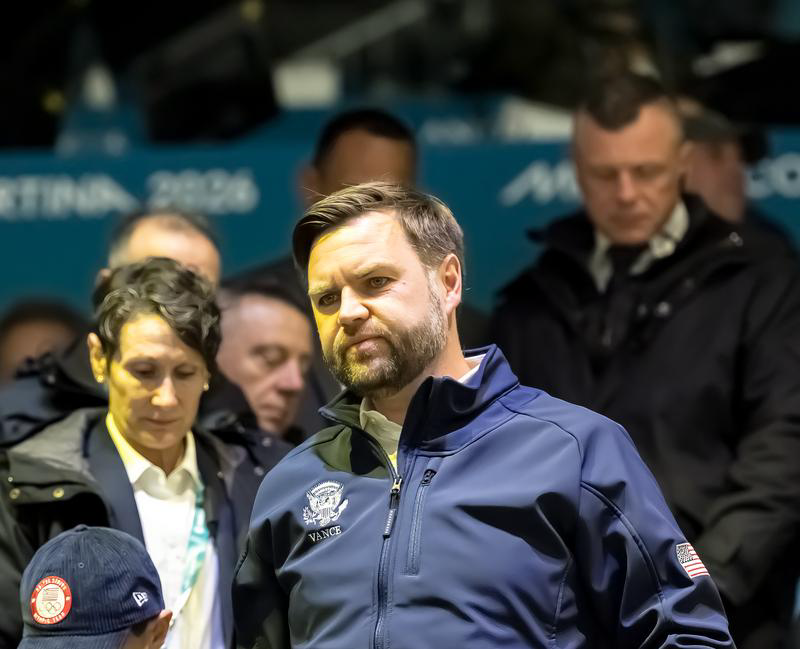
At a University of Georgia event hosted by Turning Point USA on April 14, 2026, Vice President JD Vance delivered a stunning rebuke to Pope Leo XIV, advising the pontiff to “be careful” when discussing Catholic theology — despite Vance himself having joined the Catholic faith almost seven years ago.
The 41-year-old vice president’s remarks directly challenged the pope’s recent condemnation of President Donald Trump’s military action in Iran. On April 10, the 70-year-old pontiff had declared “God does not bless any conflict” and said Christians are “never on the side of those who once wielded the sword and today drop bombs.”
Vance questioned how the pope could claim “God is never on the side of those who wield the sword,” pointing to “more than a thousand-year tradition of just war theory.” The remarks immediately sparked widespread criticism across social media and Catholic leadership.
The irony of Vance’s theological argument proved profound. Pope Leo XIV spent 12 years as Prior General of the Order of St. Augustine and became the first-ever pope from that order. St. Augustine of Hippo, alongside St. Thomas Aquinas, actually developed the just war doctrine that Vance attempted to explain to him.
Making matters more awkward, the pope was visiting the archaeological site of Hippo in Annaba, Algeria, at the exact moment Vance delivered his Georgia lecture on St. Augustine’s teachings. St. Augustine served as bishop at that very location until his death in 430. During his ongoing trip to four African countries, Pope Leo XIV planted an olive tree at the site.
Pope Leo XIV holds extensive theological credentials, including a Master of Divinity from the Catholic Theological Union in Chicago and a doctorate in canon law from the Pontifical University of St. Thomas Aquinas in Rome. He also served in the Augustinian mission in Chulucanas, Peru, providing him with decades of theological training and pastoral experience.
Vance converted to Catholicism in August 2019 at age 35, selecting St. Augustine as his patron saint. He was raised in a loosely evangelical tradition and identified as an atheist during his college years.
Other Trump administration officials joined the assault on the Vatican. White House border czar Tom Holan, also a Catholic, told the pontiff to “leave politics alone” during an April 14 appearance on Newsmax, telling reporters that the Church should “stay out of immigration because they don’t know what they’re talking about.” House Speaker Mike Johnson told reporters the just war doctrine is “a very well-settled matter of Christian theology.”
The Trump administration’s escalating feud with the Vatican over the war with Iran drew a swift response from American bishops. Bishop James Massa, 65, the auxiliary bishop of the Diocese of Brooklyn, issued a statement Wednesday on behalf of the U.S. Conference of Catholic Bishops’ Committee on Doctrine.
Massa’s statement affirmed that when Pope Leo XIV “speaks as supreme pastor of the universal Church, he is not merely offering opinions on theology, he is preaching the Gospel and exercising his ministry as the Vicar of Christ.” The bishop emphasized that Catholic doctrine requires nations to take up arms only “in self-defense, once all peace efforts have failed.”
Vincent J. Miller, the Gudorf Chair in Catholic Theology and Culture at the University of Dayton, provided a more pointed critique. The prominent Catholic theologian noted that the Church actually condemned the conduct of total war in WWII, including the obliteration bombing of cities — directly undercutting Vance’s WWII liberation argument. “The vice president’s answer shows he has much to learn about what the Church actually teaches about peace and war,” Miller said.
Andrea Tornielli, the Vatican’s editorial director, issued his own rebuttal of Vance’s just war argument. He noted that the doctrine was developed centuries ago when wars were fought with swords, not machine-guided drones. “There has been a growing awareness that war is not a path to be followed,” Tornielli wrote on Vatican Media.
Pope Leo XIV responded defiantly to the administration’s attacks, declaring he has “no fear of the Trump administration or of speaking out loudly about the message of the Gospel.”
The pontiff also issued a letter on April 14 to participants of a Vatican conference on the use of power in democratic societies. Without naming a specific country, Pope Leo warned that without a foundation in moral values, democracy “risks becoming either a majoritarian tyranny or a mask for the dominance of economic and technological elites.”
Additional scrutiny of Vance’s theological credentials emerged earlier this month when he announced his forthcoming 304-page memoir about converting to Catholicism, titled “Communion: Finding My Way Back to Faith.” The book’s cover features Mount Zion Church in Elk Creek, Virginia—a congregation of the United Methodist Church’s Holston Conference, not a Catholic church.
President Trump blasted the pope on Truth Social the weekend of April 11–12, before posting an artificial intelligence-generated image widely criticized as blasphemous, depicting himself in Christ-like imagery. Trump later deleted the post after an uproar from Christians, but refused to apologize, claiming he thought the image depicted him “as a doctor making people better.”
The incident generated viral backlash across social media, with late-night host Stephen Colbert among those mocking the vice president’s audacity in lecturing the leader of 1.3 billion Catholics worldwide.
Vance’s evolution from Trump critic to loyal defender remains striking. In 2016, a private message to his law school roommate revealed he called Trump “America’s Hitler” and “a cynical ****” before eventually joining the 2022 Senate campaign that launched his political alliance with Trump.
