
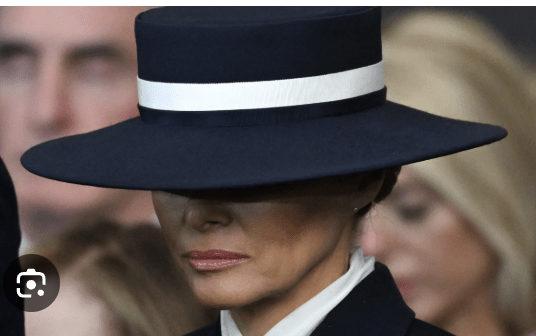
Certain poll findings hurt moderately, whereas others fundamentally alter the record books. Melania Trump has just endured the second scenario. A CNN/SSRS survey conducted between March 26 and March 30, 2026, reveals the first lady’s net favorability standing at -12 — meaning unfavorable views surpass favorable ones by twelve complete points. This isn’t just weak performance. According to CNN’s senior data analyst Harry Enten’s evaluation, it marks the worst number ever recorded for a modern first lady at this stage of a presidential administration.
To provide perspective: first ladies almost invariably enjoy superior polling figures compared to their presidential partners. Even when a president confronts severe polarization, the first lady typically maintains a reserve of public goodwill. Melania Trump has obliterated that reserve. And this deterioration wasn’t abrupt — her numbers have undergone a steady, relentless downward trajectory across multiple years. However, her present standing represents uncharted waters for any first lady.
Enten offered more than simply Melania’s standalone number. He contrasted it with every second-term first lady in contemporary history, and the findings are shocking. At the identical stage of their spouses’ second presidential administrations, Nancy Reagan maintained a +50 rating. Laura Bush registered at +46. Michelle Obama tallied +42. Even Hillary Clinton — who endured political upheaval from Bill Clinton’s sex scandal — managed a +25 rating.
Melania’s -12 doesn’t just trail these numbers. It sits 37 points beneath Hillary Clinton’s rating, who formerly held the distinction as the lowest-rated second-term first lady. This isn’t just a gap. This is a chasm. And Jill Biden, during the comparable timeframe in Joe Biden’s first term, also sustained positive figures.
Enten summarized it on air with a remark that will probably follow Melania into the future: “Melania Trump breaking records in the way that you don’t want to break records — historically awful. The American people really don’t care for her.”
The truth is, Melania wasn’t perpetually polling in negative territory. In May 2018, during Trump’s first term, she posted a +30 rating. For a first lady married to one of America’s most divisive presidents, that signified impressive performance. She had carved out her own persona — quiet, predominantly apolitical, keeping distance from Washington’s everyday turmoil. Numerous Americans valued that approach, or at least didn’t harbor strong feelings about her one way or another.
By January 2025, that +30 had plummeted to +3. Still technically positive, albeit barely. The public favor was evaporating. And subsequently, during the span between January 2025 and late March 2026, everything crumbled. A 15-point drop from slightly positive to significantly negative territory within just over a year constitutes a remarkable implosion for any public figure, particularly someone holding a traditionally uncontroversial role.
So what triggered this?
When CNN’s Kate Bolduan asked Enten regarding the catalyst for this collapse, he pointed to one especially damaging factor: “Melania: Twenty Days to History,” a self-produced documentary that debuted in theaters on January 30, 2026. Directed by Brett Ratner and produced by Amazon MGM Studios, the film followed Melania Trump during the weeks leading up to her husband’s second inauguration.
The financial commitment was massive. Amazon reportedly paid approximately $40 million for acquisition rights — roughly $26 million above the second-highest bidder, according to The New York Times reporting. They then poured an additional $35 million into marketing campaigns. This amounts to a $75 million wager on a first lady documentary.
The wager flopped spectacularly. The film collected approximately $7 million in its opening weekend, which exceeded initial projections ranging from $1 million to $5 million. President Trump championed it vigorously, calling it the “hottest” film in America and repeatedly characterizing his wife as a “movie star.” But after that initial weekend, things declined sharply.
By February 25 — less than four weeks after release — “Melania” had disappeared entirely from domestic box office charts. It wasn’t among the top 38 films in America. The film had crashed from 3,300 theaters at wide release to just 505. Total ticket sales reached approximately $17 million against that $75 million investment. In Hollywood mathematics, that represents a catastrophic loss.
Critics savaged it. On Rotten Tomatoes, the film carries an 11 percent critics’ rating. The audience rating, conversely, stands at 99 percent — an unprecedented gap between critic and viewer scores on the platform. That disparity immediately triggered suspicion, and the production was flagged for showing signs of “fake” bulk ticket purchases.
On Letterboxd, the movie suffered review-bombing before its actual release. Critics called it shallow, uninspired, and compared it to propaganda. Marketing posters in urban areas like Los Angeles faced what was described as “extensive and severe” vandalism. It became a cultural flashpoint — and not the kind Melania or Amazon had envisioned.
Choosing Brett Ratner as director generated further controversy. During the final two months of the film’s theatrical run, Ratner’s name appeared repeatedly in the latest release of the Epstein files released by the Justice Department. The movie was also criticized publicly by segments of its own production crew, and filmmakers faced accusations of using musical content without proper authorization.
Enten argued that when you look at the polling data alongside the documentary’s box office and critical failure, both pieces of evidence point to the same finding: Melania Trump is “historically unpopular for a first lady.” Many Americans viewed the documentary as a political vanity project, whatever Melania’s actual motivations. And in such a politically charged environment, that kind of perception becomes permanent.
On April 9, 2026 — the same day the devastating CNN poll numbers were released — Melania Trump made an extremely rare public appearance. She delivered a tightly controlled press statement from the Grand Foyer of the White House denying any personal connection with Jeffrey Epstein. She declined questions from reporters and offered little explanation for why the statement happened at that particular moment.
Melania firmly rejected any significant connection with the convicted sex offender and his associate Ghislaine Maxwell. “The lies linking me with the disgraceful Jeffrey Epstein need to end today,” she declared, explaining that she and the president had occasionally attended the same social events as Epstein due to overlapping social circles in New York and Palm Beach.
Addressing a 2002 email she sent to Maxwell — where she praised a magazine article about Epstein and asked Maxwell contact her, ending with “Love, Melania” — the first lady characterized the message as simply polite correspondence, brushing it off as a trivial note. Maxwell called her “sweet pea.”
She also stated that Epstein did not arrange her introduction to Donald Trump, insisting she met her husband by chance at a New York City social event in 1998, as she recorded in her book, “Melania.”
Strangely, President Trump told a reporter he had no awareness of the statement before its delivery — an unusual detail that deepened the mystery regarding why Melania chose to make a public declaration at all.
Observers view the poll and the Epstein statement as unrelated incidents — the poll data was collected before the statement was made — but the timing of both occurring on the same day certainly didn’t help matters.
Enten’s analysis also placed Melania’s numbers into a broader framework. Her approval ratings now mirror those of President Trump, whose personal numbers have hit historic lows in recent weeks. A CNN/SSRS poll showed that approval of Trump’s handling of the economy is the lowest measured during either of his terms, with only 31 percent approving. A separate Harvard CAPS/Harris survey found 53 percent of respondents say the economy is worse now than during the Biden administration.
Reuters/Ipsos polling indicated only 29 percent approved of Trump’s economic management. The ongoing war in Iran has added another layer of public dissatisfaction. In this climate, the traditional shield that first ladies enjoy — being seen as separate from political conflicts — has completely evaporated for Melania.
Enten couldn’t resist mentioning one of the most notorious moments of Melania’s time in Washington. During Trump’s first term, she wore a jacket to a migrant detention center that read “I Really Don’t Care, Do U?” It was one of those moments that becomes forever embedded in public memory, the kind of incident that resurfaces in every conversation about her real character and actual beliefs.
The irony, Enten suggested, is that the message has now turned back on her. The American public, based on the data, really doesn’t seem to care for Melania Trump. And with midterms approaching, those numbers represent a real problem — not just for her image, but for the entire Republican organization trying to hold power.
The White House response to the poll was predictably on-brand. Spokesperson Davis Ingle told reporters: “No other President in history has accomplished more for the American people than President Trump.” Which, you’ll notice, didn’t mention Melania whatsoever.
