
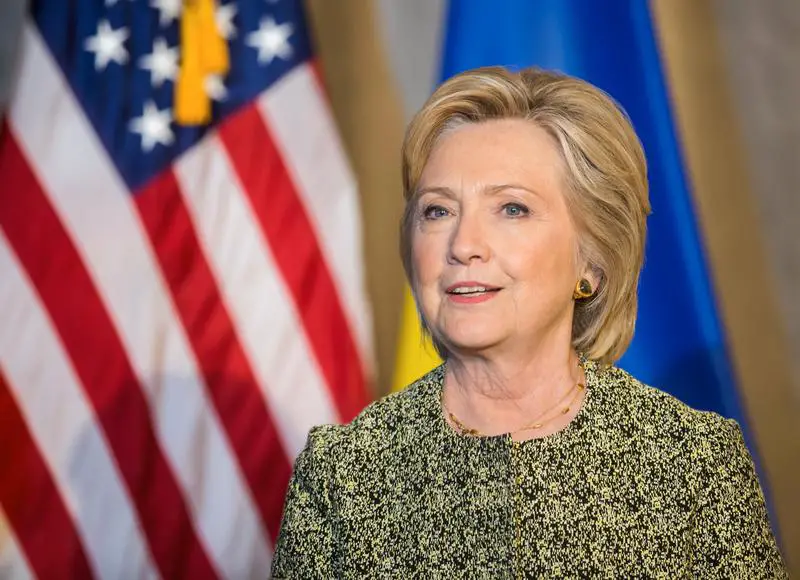
Hillary Clinton’s forecast for a President Donald Trump whose party just lost the midterms comes with a term borrowed from behavioral psychology and a prediction about Iran.
Trump told interviewers after the scale of the Republican defeat became clear that the results surprised him and that the performance of Republican candidates carried primary responsibility — the blame-first reaction Clinton predicted on ABC’s “The View” on Monday, Nov. 2, 2026, the day before voters decided control of Congress.
Clinton, the former secretary of state, former first lady and Trump’s rival in the 2016 election, argued that Republicans beaten at the polls would produce a president answering with bigger risks rather than smaller ones. She appeared alongside Kara Swisher, the journalist who co-hosts Clinton’s podcast “High Stakes with HRC.”
The two first worked through the argument on an Oct. 28 podcast episode, where Swisher laid out a scenario of a heavy Republican defeat with Democrats taking the Senate and the House. That scenario is now reality.
“What I think people need to be prepared for is he becomes even more unhinged and sadly more dangerous, because as I have mentioned before there’s a concept in behavioral psychology where people who are in what’s called the domain of loss, they double down on risk,” Clinton said.
Trump posted on his own social media platform that Republicans would have won decisively with himself on the ballot.
The Attacks She Expects on Iran
Clinton named the risk she fears most. “I think that he’s going to most likely launch more attacks on Iran, which I think put more American lives, not just military, but civilian lives at risk. And not just in the Middle East, but in other places as well,” she said.
Trump said on Oct. 8 that the U.S. was holding productive discussions with Tehran, and he pledged that American forces would not attack Iran before the Nov. 3 elections. U.S. officials told regional allies on Oct. 29 to prepare for possible renewed strikes once voting ended, according to two diplomats briefed on those discussions, who said no final decision had been made.
Trump said in an Oct. 30 radio interview that the Iran war would be “wrapped up soon,” without giving a timetable.
The president acknowledged the war with Iran as one of the factors behind the Republican defeat. He expressed no regret over the decision to attack, and said he would make the same decision again if he could go back in time.
A Lame Duck Who Demands Loyalty
Clinton predicted that defeat would push Trump to demand even greater loyalty from Republicans, and that it could cost him some of it as lawmakers grow less willing to follow him. She called him a lame duck, one who may not know it yet.
A Democratic Congress, she forecast, would try to rein him in through legislation and investigations aimed at his administration, his family, his supporters and his allies. She alleged no specific wrongdoing.
Her political read, not any polling finding, put Trump underwater on immigration, foreign policy and the economy. She argued that shame still works, citing outrage across the country that pushed officials to back away from the idea of streaming an execution. Winning is only the start, she told listeners, and Democrats then have to show they can govern on affordability and corruption.
A Democratic sweep makes none of that automatic. Inquiries depend on decisions by congressional committees, and legislation faces political and constitutional constraints.
Jeffries Draws Fire From Progressives
House Minority Leader Hakeem Jeffries drew criticism from progressives for remarks he made on MS NOW’s “Morning Joe” on Nov. 4. “The American people don’t want us to get even; they want us to get things done on their behalf because life is way too expensive,” he said.
White House spokeswoman Lauren Bis said in a statement to Fox News Digital: “As the president has said, he’s willing to work with anyone to continue delivering victories for hardworking Americans. If Democrats choose to pursue sham investigations and radical left policies, they are choosing to work against the American people.”
A Judge Tells DOJ to Stop
“The View” co-host Sunny Hostin asked Clinton whether Trump would try to interfere with the election. He had been trying, Clinton answered, pointing to legal actions and threats, efforts to seize ballots, and litigation against states telling them they are not running their elections properly and have ineligible voters.
A federal judge ordered the Justice Department on Friday, Oct. 30, not to threaten or intimidate election officials. The order followed a department request that California and Washington officials separate ballots flagged as potential noncitizens. Another federal judge dismissed the administration’s Alaska lawsuit on Sunday, Nov. 1; that suit sought to block certification of the state’s Senate race if Sen. Dan Sullivan loses.
Clinton predicted that state and local officials, along with legal groups, would answer back. The Justice Department announced on Nov. 3 that it had deployed Election Day monitors to all 50 states, its “largest monitoring effort in history.” Los Angeles Mayor Karen Bass called the move a “baseless and dangerous attack” on state election processes.
Homeland Security Secretary Markwayne Mullin dismissed Clinton’s warning on “The View” that ICE officers could intimidate voters. “I don’t understand why Hillary is still relevant,” he told Fox News host Will Cain ahead of election night on Nov. 3. “ICE agents aren’t going to be around polling places unless there’s a threat,” he added.
On Monday, Clinton described herself as an optimist who worries a lot, and said she planned to keep worrying until every vote is counted fairly and the results are in. She pointed to Democratic movement in places no one could have predicted three or six months earlier. If Democrats take both chambers, she said, Trump will be cornered and angry and will hit back, while Congress gains leverage to hold him to account. She also expects an effort to convince certain states not to certify results, and possible investigations into particular elections launched by an outgoing Republican-led Congress.
