
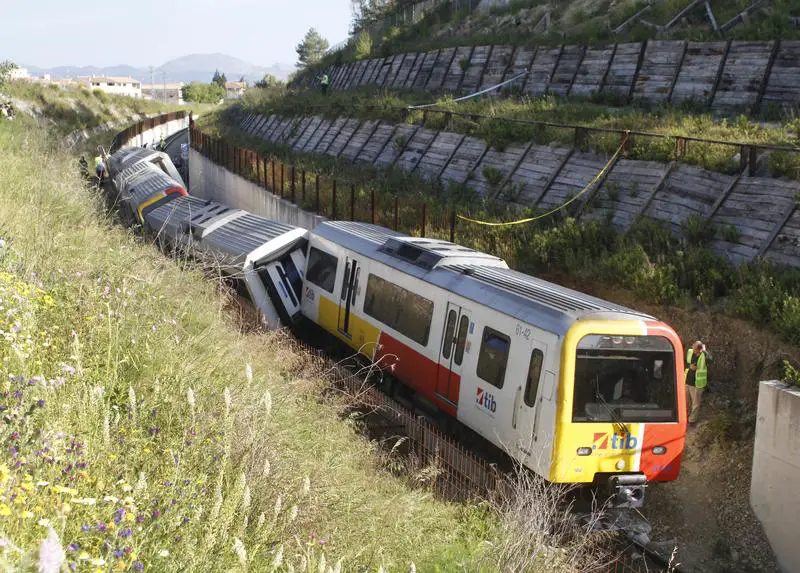
Villagers from a farming district south of Cairo ran to the tracks and began pulling passengers out of overturned carriages after two trains slammed together.
Two passenger trains collided on Sunday, Nov. 8, 2026, in the al-Ayyat district of Giza province, killing seven people and injuring at least 125, authorities said.
The trains met about 52 kilometers (32 miles) south of Cairo, between the Kafr Ammar and Al-Raqqa stations. Al-Ayyat sits near the Nile River in the south of Giza, the province known worldwide as the home of Egypt’s ancient pyramids.
More than 70 of the injured were treated and discharged, the Health Ministry said. Early reports put the death toll at four, a figure the ministry raised to seven later in the day. The driver of the Fayoum-bound train was among the dead, according to the Chief Prosecutor’s office.
Hit From Behind While Standing Still
A Giza-Fayoum train ran into the rear of a train headed for the southern province of Aswan, the Transportation Ministry said. Investigators found that it struck the rear car of the Cairo-Aswan train while that train stood still on the same track, facing the same way, officials said.
Abdel Wahed Mohamed, 31, was at a cafe nearby when the trains met. The Aswan-bound train had stopped and the Fayoum-bound train plowed into it, he said. He counted six overturned carriages and injuries that ranged from head wounds to broken limbs.
Villagers Pulled Them From the Carriages
Farha Gamal, a passenger on the Fayoum train, said in an interview that some people around her appeared dead while others struggled to find a way out of the car. “There were other cars that were completely mangled,” she said.
Survivors taken to al-Wasta Central Hospital in neighboring Beni Suef province said passengers were in shock and barely able to breathe through the dust thrown up by the impact. Villagers nearby eventually got them out, they said.
Ayman Gamal, a resident of the village of Kafr Girza in al-Ayyat, said neighbors reached the wreck, pulled survivors out and called ambulances. He watched about 80 injured people loaded into ambulances and driven to nearby hospitals. Passengers trapped inside one car of the stationary train were dead when crews pulled them free, he said.
Ahmed Moussa, 25, another witness, said rescuers dug under one overturned carriage to reach trapped passengers, and that two of the dead were women. Taha Abdel Tawab, 43, said he “saw a young man leaving the train carrying his dead father.”
More than 70 ambulances were sent to carry the injured to nearby hospitals, and the patients were distributed among three of them — Al-Wasta, Al-Ayyat and Atfih. Egyptian Red Crescent volunteers worked at the crash site on Nov. 8, handing out relief supplies and offering psychological counseling to survivors and relatives.
Health Minister Khaled Abdel Ghaffar said medical teams were treating patients for fractures and head trauma.
El-Sissi Orders a Prompt Investigation
President Abdel-Fattah el-Sissi wrote on social media that he had ordered a prompt investigation into the crash so that anyone responsible would be held to account. “I am following the aftermath of the train collision with great concern and extend my deepest condolences to the families of those who lost their lives, along with my sincere wishes for a speedy recovery for the injured,” he said.
Calls for Egypt’s transport minister to step down mounted on Sunday, Nov. 8, after the collision.
Investigators from the Chief Prosecutor’s office reached the site late Sunday. Late Monday, Nov. 9, prosecutors ordered two railway officials detained — the controller and the stationmaster at Al-Raqqa station — after they admitted failing to monitor the control panel for a signal tower. The controller was also found to have tampered with the signals logbook to hide his negligence, prosecutors said. Investigators found that the driver of the Fayoum-bound train had disabled its automatic control system before the crash, and the driver’s assistant was held for questioning.
Transport Minister Kamel el-Wazir faced about six hours of questioning by parliament’s transport committee on Tuesday, Nov. 10, and admitted failings in the rail network. “We acknowledge that there are mistakes, and our aim is to prevent accidents or reduce them,” he said. He told lawmakers that disabling the automatic control system is now punishable by dismissal and that he did not know why it had been switched off. Some lawmakers renewed calls for his resignation, while others said blame should be left to investigators.
Emergency crews and cranes worked into Sunday night, clearing the wreckage so service could resume quickly, according to the Egyptian Railway Authority. Rail service between Giza and the Upper Egypt region was halted on Nov. 8 while the crews worked.
The Same District as 2002
Egypt’s deadliest rail disaster struck the same district, when a fire on an overnight train from Cairo to southern Egypt killed more than 300 people in 2002. Multiple crashes in the area killed dozens in 2009, and in September 2026 two freight trains collided in al-Ayyat, derailing a locomotive and two cars.
Crashes and derailments are frequent in Egypt, where the rail network has long suffered from mismanagement and poorly maintained equipment despite a government promise of modernization in recent years. Severe rail accidents climbed from 289 in 2020 to 752 in 2024, according to Egypt’s Central Agency for Public Mobilization and Statistics, even as total reported crashes declined.
A passenger train traveling from Matrouh, a western Mediterranean province, to Cairo derailed in western Egypt in August 2025, killing at least three people and injuring 94 others, authorities said. Seven wagons came off the tracks and two overturned, railway authorities said, and the Health Ministry said 30 ambulances were dispatched to carry the injured to hospitals. Railway authorities said an investigation was under way to determine the cause.
