
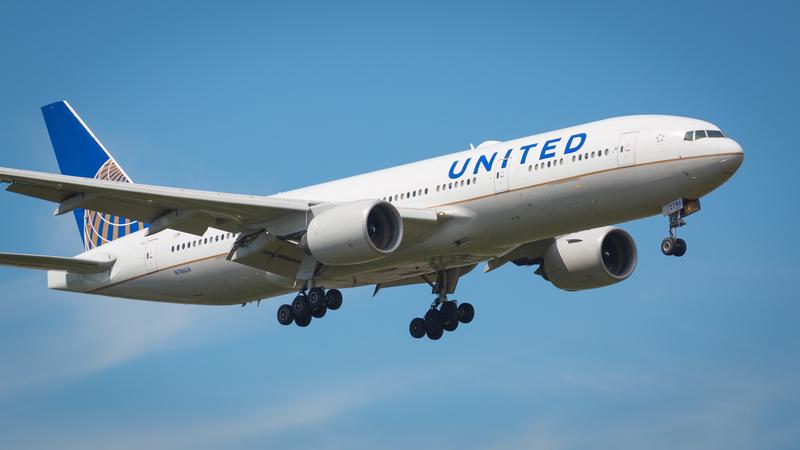
Passengers on a Honolulu-to-Los Angeles flight were watching movies and settling in for landing when the cabin dropped and lifted people out of their seats.
The Federal Aviation Administration confirmed it will investigate the severe turbulence that injured four United Airlines flight attendants during the descent of Flight 1157 on Wednesday night, Oct. 21, 2026.
The Boeing 777 landed safely at Los Angeles International Airport carrying 190 passengers and 10 crew members. United said no customers were injured and that the aircraft encountered turbulence during descent.
The jet, a Boeing 777-200 registered N769UA, left Daniel K. Inouye International Airport in Honolulu at approximately 1:00 p.m. local time for the 2,539-mile service to LAX. The turbulence struck during descent, reportedly at around 27,000 feet.
A Loud Bang, Then Falling
Coral Pena, a passenger on the flight, heard a loud bang at impact. “We just started falling, and I was like, ‘Oh my God,’” she said.
Marly Wadlington, a San Diego resident aboard the flight, said she was watching a movie when the plane dropped, and the fall felt long to her. The cabin shook, people yelled and passengers were scared, she said.
A passenger from Lake Havasu, Tami Dandoy, said the jolt lifted her and others clear of their seats. Melinda Sabosky, who was also on board, described a small bump that sent them flying, though she could not tell how far the plane dropped.
One passenger said a travel companion’s head came close to striking the cabin ceiling. Another passenger said she saw a flight attendant bleeding from the head and leg.
Neck and back injuries affected at least two of the injured crew members. In-flight communications indicated the two are women, ages 62 and 58.
The Drop Recorded by Flight Data
The 31-year-old Boeing 777 lost as much as 3,675 feet in a single minute, according to flight data covering roughly the last 20 minutes of the trip. Because the aircraft was already descending, the figure does not necessarily indicate an uncontrolled drop caused by turbulence, and the full altitude change cannot be attributed to turbulence without further investigation. Two minutes and 30 seconds carried the jet down from 22,800 feet to 14,000 feet, after which it pressed on toward Los Angeles at a more conservative rate.
A United flight had made the same Honolulu-to-Los Angeles run before it, and that aircraft never reached a descent rate steeper than 2,725 feet per minute. It held that rate only briefly.
A Couple of Seconds, Then Smooth
Flight audio indicated the crew had run into wake turbulence. “It only lasted a couple of seconds, it felt like wake turbulence, but we’re smooth now,” the pilot said in a radio call to air traffic control.
In the FAA’s description of wake turbulence, one aircraft generates two counter-rotating vortices that another then flies into. The agency says those vortices can injure people on board because they can roll a plane harder than its own controls can counter.
Waiting on the Tarmac for a Gate
The plane sat on the tarmac at least 30 minutes after touchdown with the injured flight attendants still on board, waiting to reach a gate. The flight arrived 20 minutes late, according to flight data.
United said medical personnel saw four flight attendants after the landing, and the airline said one of the four was hospitalized. The airline said medical personnel evaluated its injured employees and that none of the 190 passengers reported injuries.
The precise cause remains unconfirmed.
