
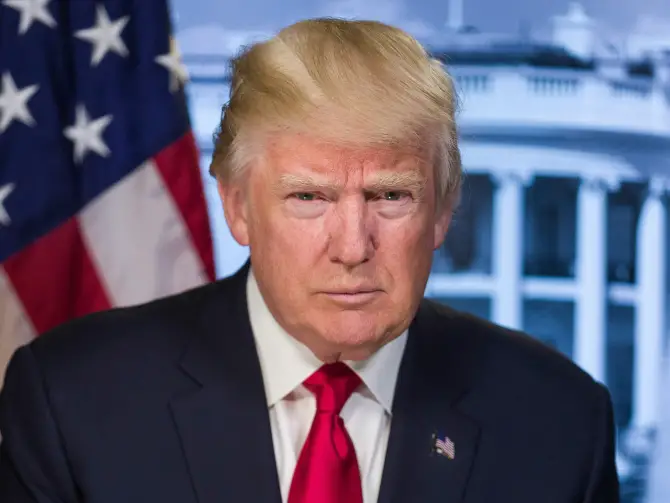
President Donald Trump signed the White House Accord on Super Intelligence with six technology executives at the White House on Tuesday, Sept. 29, 2026, after a luncheon with industry leaders. Beneath his signature, the document names him president of the “Unites States” — a single wrong letter.
No one has explained how the misspelling reached the signature block. The White House did not immediately respond to USA TODAY’s request for comment on the misspelling, as of the article’s Oct. 1 update.
The typo has overshadowed the document’s contents and dominated the rollout. California Gov. Gavin Newsom was among those who mocked it, and the document spread online with the error intact. Trump’s Truth Social account shared the signed text that Tuesday, Sept. 29, while the White House’s social media account posted it Sept. 30.
The Federal Register has yet to publish its copy, and whether that version will match remains unknown.
Who Signed the Accord
Four of the signatures came from men signing as head of his company: Sundar Pichai, the Google CEO; Dario Amodei, the Anthropic CEO; Mark Zuckerberg, the Meta CEO; and Jensen Huang, the Nvidia CEO. Greg Brockman signed for OpenAI. Elon Musk signed as SpaceX CEO, although some accounts list him as an “xAI Founder.” The pact names Google, Anthropic, Meta, OpenAI, xAI and NVIDIA. Regular meetings to develop safety standards and best practices are what the companies agreed to, under a text that also goes by the name Joint Commitment on Frontier Responsibilities.
Trump calls the accord “morally binding” and has framed it as a historic moment of cooperation between Washington and Silicon Valley. “It’s almost like a constitution in a way, and the biggest people in the world signed that, and I signed it as president, and it really is a form of protection,” he said of the signing.
Zuckerberg, speaking to press after signing the accord on Sept. 29, said “the basic idea” is to “give the American people and our customers confidence that the technology works in the way that we intend.” He added that currently every company was building something with different sets of standards.
What the Pact Asks
Companies that sign on are asked to maintain robust internal controls so their systems behave as their developers intend, to bring in an independent outside auditor, and to create a board-level committee fed by reports from the teams that run those controls. That last requirement arrives in garbled wording of the document’s own.
The text describes four layers of controls and audits: safety monitoring inside the company during training; an internal team that confirms the first layer is working; an outside auditor that assesses the safety controls independently; and an independent board named by each firm to review reports on them.
The companies presumably already have such controls and teams, the Council on Foreign Relations’ Connor Martin wrote Oct. 1, and those have not prevented reported cases of AI breaking out of its training and evaluation environments.
No Enforcement Mechanism
None of those controls involve a federal regulator, and nothing in the text promises a public release of what the independent evaluations find. Firms could, as written, pick their own evaluators, appoint their own boards and decide for themselves whether to publish results. Neither an enforcement mechanism nor legal force backs the pact, which Trump has described as a voluntary arrangement with a “tremendous self-policing aspect.”
Governance principles that participants intend to put in place inside their own organizations were what the meeting produced, according to Exiger CEO Brandon Daniels, who attended the Sept. 29 White House gathering and spoke to NewsNation. Those principles, he said, include quality assurance and safety reviews, independent audits, board-level oversight and possibly a central body to govern super intelligence.
A run of incidents in which products from major AI companies hacked into outside organizations during safety tests has put the industry’s safety record under renewed scrutiny. Lawmakers, researchers and some AI firms have pressed for more federal oversight. Trump has largely brushed off calls to slow down, pointing to competition with China and the risk to economic growth. Strict regulation would hobble the economy, argues the tech industry, which has aligned itself closely with his administration and lobbied against such rules.
A New Super Intelligence Force
Trump followed the accord with a Truth Social post on Sunday, Oct. 4, announcing a new “Super Intelligence Force.” Federal outreach to consumers, public-interest and religious groups, critical infrastructure providers and technology companies will fall to the force, or SIF, he said. He wrote that it “will report to the President of the United States (ME!), and the Chief of Staff, Susie Wiles.”
In the same post, Trump said the SIF will work to “ensure that America continues to lead the World in Super Intelligence, which many say is bigger than the Industrial Revolution, and the Internet.” Leading it are Jay Clayton, the Director of National Intelligence; Andrew Ferguson, the Federal Trade Commission Chairman; Emil Michael, the Under Secretary of War for Research and Engineering and Chief Technology Officer; and Scott Kupor, the Office of Personnel Management Director.
Trump also signed an executive order on Sept. 29 replacing “Artificial Intelligence” with “Super Intelligence” across the executive branch. The order was “similar to a declaration he made at the United Nations last week,” in the week before Sept. 29. The order directs every department and agency to use “Super Intelligence” and “SI” in official correspondence, public communications, policy documents and non-statutory documents, and to stop acknowledging “Artificial Intelligence” and “AI” altogether. The Assistant to the President for Science and Technology draws the task of proposing a federal definition of the new terms and identifying any further executive action needed to carry out the change.
SpaceXAI will be renamed SpaceXSI, Musk said in a post on X on Oct. 4, replying “Yes, we will make that change” to a user who asked about the switch. In another post he wrote, “No more AI. SI. It’s better.” In a separate post, he wrote, “I love SI slopcore.”
A White House fact sheet dated Sept. 29, titled “President Donald J. Trump Inaugurates The Era of Super Intelligence,” argues the new name better captures what the technology can do. The fact sheet says the United States has led the field for more than 70 years and credits Trump with scrapping Biden-era policies it calls overreaching and harmful. The Genesis Mission, a national push to speed breakthroughs in science, medicine, energy and manufacturing, draws a citation for the more than $5 billion announced for it. The document also flags more than 90 federal actions identified in America’s AI Action Plan, released in July 2025.
America.gov, a website billed as an AI-powered one-stop shop for federal services and information, was the occasion for an earlier preview of the rebrand: Trump unveiled the site on Sept. 29 at the Andrew W. Mellon Auditorium in Washington, D.C. He had floated the “super intelligence” label at the United Nations General Assembly the week before.
What people are sharing most from the rollout is not a policy provision but a misspelled country.
