
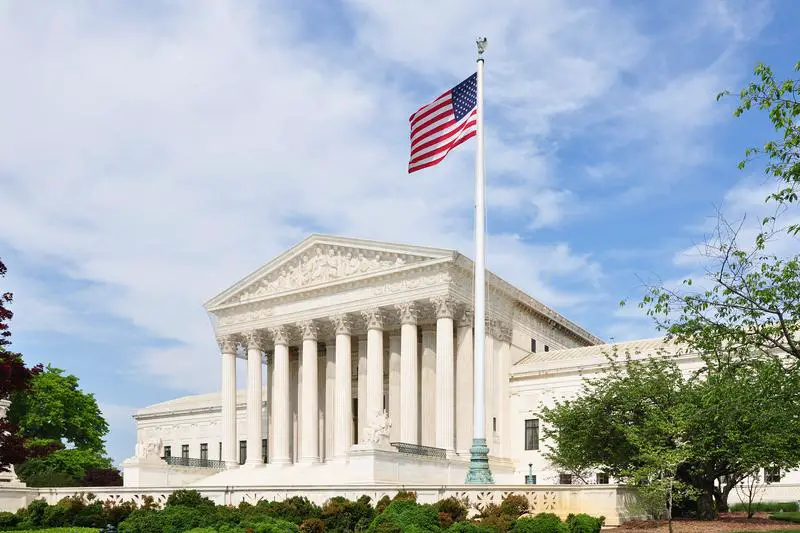
The Supreme Court just handed President Donald Trump a fresh opening in his fight to keep the inner workings of Elon Musk’s DOGE under wraps.
The Supreme Court agreed on Tuesday, Oct. 13, 2026, to take up the Trump administration’s effort to keep records from Elon Musk’s Department of Government Efficiency (DOGE) out of public hands.
The case, which began as CREW v. U.S. DOGE Service, reached the justices on an appeal from the Justice Department, which asked the court to step in. Citizens for Responsibility and Ethics in Washington (CREW), a watchdog group, brought the underlying suit seeking records from DOGE’s work during the early days of President Donald Trump’s second term.
The justices did not decide who wins. They agreed only to take up whether, and how far, discovery can proceed in the case.
At the heart of the dispute sits the Freedom of Information Act (FOIA), and whether DOGE counts as a federal agency subject to it. CREW argues that it does, while the administration maintains that DOGE was a presidential advisory body the law does not reach.
A ruling is due by the end of the term, in late June or early July 2027, and the Justice Department asked on Monday, Oct. 19, for a briefing schedule that would let the case be argued in February 2027. The outcome could decide how much the public ever learns about DOGE’s inner workings.
Second Trip to the Justices
The case could move to discovery, U.S. District Judge Christopher Cooper held on April 15, 2025, in the U.S. District Court for the District of Columbia. He had already ordered the government in March 2025 to process the group’s records request on an expedited basis.
A panel of the U.S. Court of Appeals for the D.C. Circuit also sided with CREW. The Justice Department went to the Supreme Court with an emergency appeal in May 2025, and Chief Justice John Roberts temporarily paused the discovery orders on May 23, 2025.
A conservative majority found on June 6, 2025, that Cooper had ruled too broadly. The requests at issue sought what DOGE recommended and whether agencies followed those recommendations, and they were “not appropriately tailored,” the court said.
CREW trimmed its requests after that ruling. The government objected anyway, and the case returned to the justices for a second time.
A Sworn Deposition for Gleason
CREW lawyers won clearance from the appeals court to take a sworn deposition of DOGE acting administrator Amy Gleason. That permission, the administration argues, was never the panel’s to grant.
The Supreme Court had told the lower court to weigh separation-of-powers concerns, and the administration says the judges skipped over that instruction, eroding the independence and confidentiality that presidential advisers rely on. Solicitor General D. John Sauer argued that the appeals court’s ruling “intrudes into the autonomy and confidentiality of presidential advisors.”
CREW says the appeals court did exactly what the Supreme Court told it to do. Pointing at the president’s own words, the group’s lawyers wrote that undisputed facts in the public record, including Trump’s statements, confirmed DOGE was “wielding enormous independent authority across the federal government.”
Nikhel Sus, CREW’s chief counsel, told Politico: “The lower courts have uniformly ruled that CREW is entitled to discovery in this case.” He added, “We will continue to pursue transparency for the American people.”
Thousands Fired, USAID Dismantled
Musk, a former administration adviser, spearheaded DOGE, whose work helped fire thousands of federal workers and canceled government funding. The operation also dismantled the U.S. Agency for International Development (USAID). It drew a string of lawsuits in Trump’s early months back in office, and it has since disbanded.
CREW filed its FOIA request on Jan. 24, 2025, hoping to learn how DOGE was structured and what it was telling other agencies. No documents ever arrived, so the group sued.
CREW President Noah Bookbinder said on Feb. 20, 2025, announcing the lawsuit, that the U.S. DOGE Service and the Office of Management and Budget (OMB) were behaving as though the records law did not apply to them — and that it does.
Johnson Signed FOIA in 1966
President Lyndon B. Johnson signed FOIA into law in 1966, and the statute handed the public the right to ask any federal agency for its records. “A democracy works best when the people have all the information that the security of the Nation permits,” Johnson said at the signing, while noting that personal privacy and confidential deliberations also needed protection.
A democracy depends on citizens who know what their government is doing, and that belief underpins the law, according to Sara Creighton, an associate professor at Georgetown Law and the former deputy chief counsel at American Oversight.
Experts say government transparency could be reshaped by the ruling well beyond this one lawsuit.
