
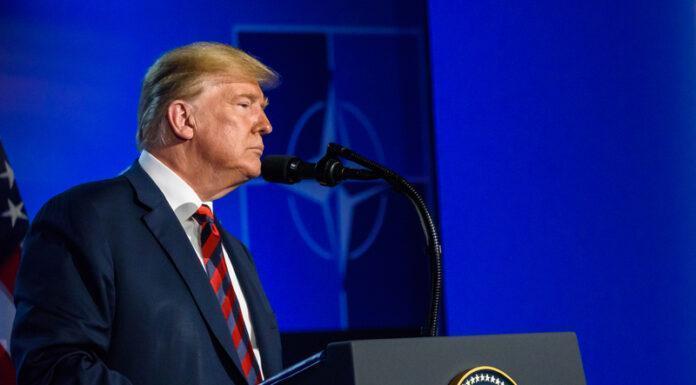
Russia will not move against NATO, President Donald Trump told reporters in the Oval Office on August 27, 2026, brushing aside the possibility and pointing to his own dealings with Russian President Vladimir Putin as the reason — even as US intelligence warnings pointed the other way.
“He’s not going to be attacking a NATO territory,” Trump said when asked whether Putin had given him that assurance.
Asked whether CIA Director John Ratcliffe had delivered such a warning in Moscow days earlier, the president declined to comment but insisted again that Russia would not strike.
The administration never announced Ratcliffe’s August 25 flight to the Russian capital. Two sightings gave it away that day: a US Air Force jet touching down at a Moscow airport, and a diplomatic motorcade making its way through the city. No CIA director had made the trip to Russia in the job before, and no agency chief had gone since William Burns, then-CIA Director, cautioned the Kremlin in November 2021 against sending troops into Ukraine. Three months after that warning, Russia invaded.
What the CIA Chief Took to Moscow
The message he reportedly carried to his Russian counterparts was twofold: hands off NATO member states, and an end to Moscow’s economic and military support for Iran at a moment when Washington is working to squeeze Tehran’s finances. Further US sanctions would follow, he also warned, if the Strait of Hormuz stays closed to shipping traffic. A senior Ukrainian official said Kyiv had been informed that a US delegation was heading to Moscow, along with a request that Ukraine hold off on its strikes for as long as the Americans remained in the country.
Behind the trip sits an intelligence picture bleaker than the president’s public assessment. In Ukraine, Russia had slipped into an increasingly weak position, US officials concluded — and that vulnerability, in their reading, could push Moscow toward action against NATO, driving up the cost of backing Kyiv until a settlement on Moscow’s terms became unavoidable. Putin likely believes Washington will not risk another conflict because it would collide with American public opinion, one recent assessment found. Nothing pointed to an imminent attack, yet weeks of warnings had put sabotage, cyber or drone operations, and even a land grab in Europe on the table.
A narrower menu of provocations appeared in earlier assessments — cyber and hybrid operations on alliance soil, kept below the threshold of conventional war. The goal, in that reading, was not to ignite a war but to test how united NATO remains and how far the Trump administration is willing to go in defending allies. The examples officials cited included drones entering Romanian airspace, a Russian missile that crossed into Poland on July 30, and an uptick in suspected sabotage and hacking across Europe.
Mutual defense among members is the expectation set by Article 5 of the NATO treaty, and the September 11, 2001, terrorist attacks prompted the United States to invoke it. A limited assault within the next few years could be Putin’s way of testing the alliance, according to reporting on leaked intelligence.
Lowering the temperature has already been Trump’s aim. Radio host Glenn Beck interviewed him on August 26, and the president described the trip as semi-routine, dismissed the notion that either a NATO threat or Iran sanctions figured in it, and turned the discussion to ending the war in Ukraine, remarking that something might come of Ratcliffe’s visit.
Moscow Dismisses the Reports
“A lot of such scare stories are being published right now,” Kremlin spokesman Dmitry Peskov said at his daily briefing on Thursday, August 27. The accounts bear no relation to reality, he added, and it is Russia that is the target of an aggressive policy from European countries. Ratcliffe met Russian intelligence officials but did not see Putin, he said. Achieving its aims peacefully is what Moscow would prefer, Peskov said of the war, but with no such option available it is pressing on with what it calls its special military operation. Ukrainian calls for direct talks between Putin and Ukrainian President Volodymyr Zelenskyy have been repeatedly rebuffed by Russia, which demands instead that Kyiv withdraw from the eastern Donbas region.
Sergei Naryshkin, Russia’s foreign intelligence chief, confirmed the meeting in remarks carried by state media. Nothing about it was unusual, he said; the subject matter fell within the remit of intelligence services, which he described as delicate and special, and the two of them talked it over.
Washington’s alarm is not shared by Europe’s spy services. Speaking on condition of anonymity, a senior European Union official said there is no risk of a Russian attack on European NATO countries in the view of European agencies, an assessment that has not shifted.
The War Grinds On
The fighting did not stop, whatever passed between the intelligence chiefs. Missiles and drones hammered Ukrainian cities overnight into Thursday, August 27, and explosions rolled across Kyiv through the morning. The Russian Defense Ministry described the barrage, launched after nightfall on Wednesday, August 26, as a massive strike on nine Ukrainian cities, and said it hit war-related sites: industry, oil refineries, logistics hubs and port infrastructure. Drones also struck three major distribution centers, destroying storage facilities operated by a toy retailer and a candy maker while damaging one run by an electronics retailer.
Four and a half years into the full-scale invasion, Ukraine remains desperately short of US-made Patriot interceptors capable of knocking down Russian ballistic missiles. On Friday, August 28, Zelenskyy said Ukrainian forces hit a Russian Tu-95MS missile carrier at the Engels base, in an operation he credited to the Alpha unit of Ukraine’s SBU domestic security service. In the south, Kherson regional Governor Oleksandr Prokudin urged residents — especially families with children and the elderly — to leave, saying attacks on critical infrastructure are intensifying by the day.
Alaska was the setting for the last meeting between Trump and Putin, on August 15, 2025, and their most recent known phone call came in June 2026.
Ratcliffe is among the highest-ranking American officials to set foot in Russia since the invasion began in 2022, and the first senior Trump administration official to travel to Moscow in months.
