
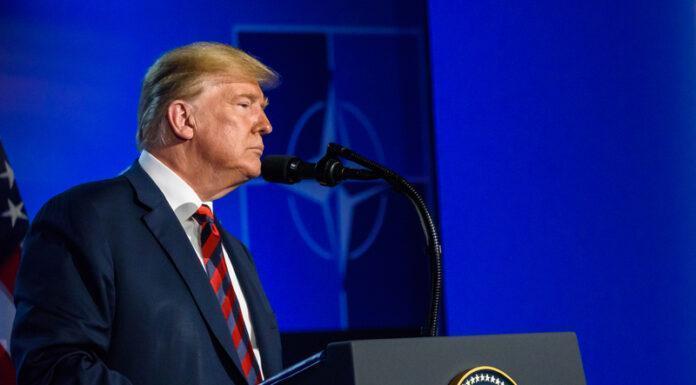
Richard Painter, who was chief White House ethics lawyer under President George W. Bush, says the $45,000 cash payments President Donald Trump handed three of his closest aides could put the president himself in jeopardy. “President Trump could get himself impeached for it,” Painter told Newsweek in remarks published Wednesday, September 9, 2026.
As Painter reads the law, the money was never a gift at all but an illegal supplement to the aides’ federal salaries — a characterization the White House rejects.
His position is a lawyer’s opinion rather than a court ruling or a formal proceeding. On September 11, though, three former White House ethics advisers — Norm Eisen, Richard Painter and Virginia Canter, who advised Presidents Obama, Bush and Clinton — wrote to the Department of Justice calling for an immediate investigation, saying the cash gifts appear to violate 18 U.S.C. Section 209 by illegally supplementing the aides’ federal salaries. No authoritative ruling has been issued, and specialists remain publicly split over whether the payments run afoul of the statute Painter cites.
What the Disclosures Show
A “cash gift for the holidays” of $45,000 from Trump appears on the filing of Natalie Harp, executive assistant to the president. A $45,000 gift also shows up on the forms of communications adviser Margo Martin and of Chamberlain Harris, deputy director of Oval Office operations, financial disclosure statements show. Walt Nauta, director of Oval Office operations, disclosed a separate $20,000 gift, which brings the combined total for the four aides to $155,000.
What drew attention was the scale. Harp, Martin and Harris are each paid about $150,000 a year, putting $45,000 at roughly 30 percent of an annual salary. Nauta earns $175,000, so his $20,000 gift lands closer to 11 percent of his pay.
Democracy Defenders Fund said the money “effectively boosted staffers’ compensation to $195,000, effectively matching the salary rate of the president’s most senior advisors,” and that the payments were structured to close the pay gap.
The administration released the four forms, which cover 2025, in September 2026. Filers of public financial disclosures must report gifts from any single source totaling more than $480 during the reporting period, subject to exclusions. Those same filings show that earlier paychecks for the aides had come from his transition operation, from Save America or from Donald J. Trump for President 2024, Inc.
Days after the disclosures surfaced, the White House’s Rapid Response 47 account called journalist Aaron Rupar a “sick, deluded freak” after he posted an image of Harp accompanying Trump on his weekend trip to Ireland. The account later accused him of making “creepy things” about women who work for the administration.
All three women worked for Trump long before the current administration. Harp, 35, joined his political operation in 2022 before moving into the White House. Her nickname on the 2024 campaign was “the human printer,” earned by hauling a portable printer around and handing the candidate printed news articles and social media posts. Trump’s first administration employed Martin, who then stayed on with his post-presidential staff in Florida. Harris also served in the first administration, went on to work for his political organizations, then returned to the White House in 2025.
Harp has since turned up in campaign rhetoric. At a recent midterm campaign rally, Democratic Sen. Jon Ossoff of Georgia invoked her by name in describing the president: “He doesn’t want to do the job. He wants to build his ballroom and travel with Natalie.”
The Law at the Center of It
The provision Painter points to dates to 1962: 18 U.S.C. Section 209, titled “Salary of Government officials and employees payable only by United States.” Broadly, it bars executive branch employees from accepting compensation, or a supplement to their salary, from anyone but the federal government for their work as government employees.
Not every financial benefit is off limits. Bona fide retirement, insurance and other benefit programs operated by former employers remain open to employees, and several specific government programs and circumstances fall outside the statute under carve-outs written into the law. A Section 209 fight typically comes down to one question: was the money compensation for government service, or was it provided for some other reason?
Painter’s argument is that salary, not a present, is what changes hands when a former boss gives a longtime employee a large sum after that employee enters government. “Employers and employees don’t have gift-giving relationships,” he told Newsweek. “If your employer gives you $50,000 at the end of the year, that’s not a gift, that is salary.” Prosecutors could criminally charge both the employee and the person making the payments under the statute, he said, and a future Justice Department could revisit the payments under a five-year statute of limitations even if the current one does not.
Painter separately told The Washington Post: “He’s clearly trying to make it easier for them financially to work in government service at the White House. You can’t do that.” Of the disclosures, he also wrote: “A White House staffer is not your Fifth Avenue doorman.”
Norm Eisen, co-founder and executive chair of Democracy Defenders Fund, said in the group’s September 11 release: “Calling these shady payoffs ‘gifts’ doesn’t change the fact that they appear to be illegal. The American public deserves to know what kind of personal loyalty this administration is attempting to buy with cold, hard cash.”
Nobody has been charged, so any penalty remains hypothetical. Violators face fines, civil penalties and a prison term of up to a year under federal law — as long as five years when the violation is willful — and a court may be asked by the Justice Department to order a halt to conduct that breaches the statute. Certain payments made before the recipients became government employees fell outside Section 209, a 1990 Supreme Court ruling held.
The White House Pushes Back
White House spokesman Davis Ingle said in a statement: “The President has a longstanding practice of giving Christmas gifts to people in his orbit, including at times employees and aides, both in government and in his time in the private sector.”
The statement went on: “The gifts at issue here have nothing to do with any of these individuals’ official government duties, and therefore are entirely permissible under relevant legal and ethical standards.”
Other specialists land in between. Dave Aronberg, a former Palm Beach County state attorney, said a real legal question arises from the size of the payments and that whether the money was compensation for government service is the decisive issue; a genuinely personal gift, he said, would be easier to defend. An explanation is demanded by sums this large, John Ronquillo, who teaches public policy as an associate professor at the University of Maryland, told CNN. “It’s not a trivial amount and so that should raise red flags for a lot of people,” he said, “who are watchdogs, who are ethics experts in terms of why, why is this happening.”
Don Fox, former acting director of the Office of Government Ethics under Obama, has said the publicly known facts don’t necessarily establish a violation, while raising concern that unusually large personal gifts could create a sense of obligation. Sean Cooksey, a former JD Vance counsel, has argued the payments don’t violate applicable rules.
What Impeachment Would Require
Impeachment is a political process, not a prosecution. A simple majority in the House of Representatives impeaches; conviction and removal take a two-thirds majority in the Senate. The Democrats’ 214 House seats sit just behind the 218 held by Republicans, with one independent and two vacancies. Voters decide all 435 seats on November 3.
Trump knows the process firsthand. Two impeachments came out of the House during his first term, in 2019 and again in 2021, and the Senate acquitted him both times.
The University of Minnesota Law School employs Painter as a teacher, and he held the chief White House ethics lawyer job from 2005 to 2007. He serves as vice chair of Citizens for Responsibility and Ethics in Washington (CREW) and left the Republican Party in 2018. In 2017 he joined the legal team on a CREW lawsuit accusing Trump of violating the Constitution’s foreign emoluments clause. A federal judge dismissed it for lack of standing that December; an appeals panel revived it in 2019 before the full Second Circuit undid that ruling, and the Supreme Court ended the case as moot in January 2021, days after Trump left office.
