
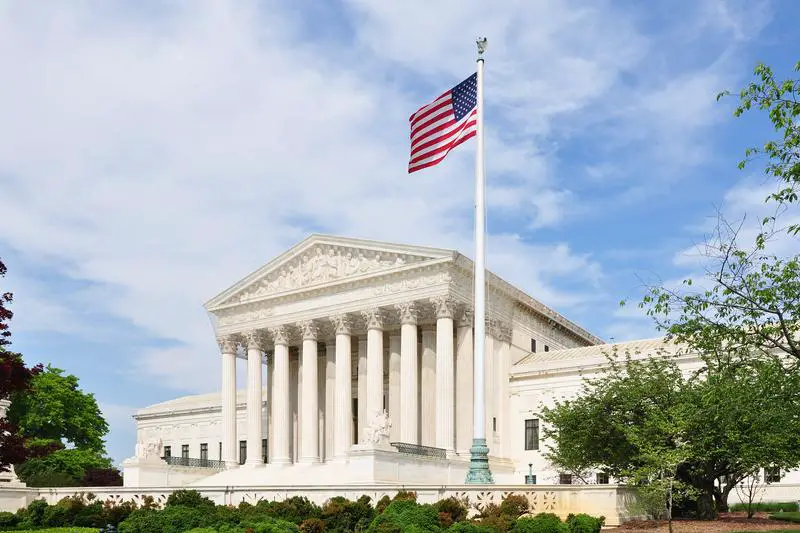
Missouri may not run its November election on the congressional map President Donald Trump endorsed, the U.S. Supreme Court decided Thursday, September 10, 2026, granting an emergency stay that leaves the state’s 2022 districts in force for the general election — even though the state’s primary was already conducted on the new lines.
No justice publicly dissented. The justices offered no reasoning, issuing a brief, unsigned order of the kind the court routinely produces on emergency applications: “The application for stay presented to Justice [Brett] Kavanaugh and by him referred to the Court is granted.”
What the Stay Does Not Do
Procedure, not substance, drove the action. The justices reached no judgment on the merits, made no finding that the map was unconstitutional, and wrote nothing: the U.S. Supreme Court issued no opinion. What it did was freeze a ruling from Stephen Clark, who serves as chief judge of the federal district court covering eastern Missouri, for the duration of the litigation. With Clark’s order on ice, the only governing court order left is the Missouri Supreme Court’s, and that means the 2022 congressional map. The map has now been blocked for a second time.
Two Courts, Two Conflicting Orders
The redrawn districts, known as HB 1, won approval from Missouri Republicans in 2025. Missouri Gov. Mike Kehoe then signed the plan into law in September 2025. A unanimous Missouri Supreme Court held on September 3 that the new districts had never legally taken effect, and that the older map governs unless voters sign off on the change. Missouri Secretary of State Denny Hoskins, a Republican, had argued that bypassing the new map would bring confusion, expense and practical difficulties; the court was unpersuaded.
Missouri Attorney General Catherine Hanaway took an emergency appeal to the U.S. Supreme Court. The Missouri Supreme Court’s ruling survived that appeal: Justice Brett Kavanaugh, who handles emergency appeals from Missouri, declined on Tuesday, September 8, to disturb it, and he denied Hoskins’ request on his own rather than sending it to his eight colleagues.
Clark issued a temporary restraining order within an hour of that decision becoming public, instructing the state to use the 2025 map. Republican Rep. Robert Onder, whose seat covers Missouri’s 3rd Congressional District, had filed the federal case on September 4, joined by another congressional candidate and two individual voters. In Clark’s view, the federal challengers would suffer irreparable harm absent his order, since many Missouri voters would otherwise be picking in November from nominees they had no role in selecting.
Both Referendum organizer Richard von Glahn and the group People Not Politicians had intervened in the federal suit, and on the night of September 8 the two of them asked the 8th U.S. Circuit Court of Appeals to put Clark’s order on hold. That request failed at the appeals court on Wednesday, September 9, and the organizers went to the justices that afternoon with an emergency stay application docketed as People Not Politicians v. Onder. Hoskins and the remaining plaintiffs got a deadline from Kavanaugh of 10 a.m. EDT on September 10 to file their answer. Von Glahn argued that the U.S. Supreme Court lacked the power to weigh in at all, because the Missouri Supreme Court’s ruling rested only on state law.
A Primary and a General on Different Maps
Voters in Missouri’s primary election, held August 4, cast ballots under the new districts, while the November general election will now run on the 2022 map. Nine days remained before the deadline to send ballots to military and overseas voters when the order came down. Which districts apply this fall remains unresolved.
The Missouri Supreme Court’s order is now the only one in effect, Hoskins said in a statement. “In accordance with that order, my Office is directing local election authorities to use the 2022 congressional map,” he said. A contempt hearing on Thursday, September 10, was where that same Court had ordered him to appear, after he told local election officials to use the new districts, and that hearing survived a federal judge’s refusal to halt it before the U.S. Supreme Court acted.
Reaction and the November Ballot
Repeated legal victories had defended what she called Missouri’s fair and lawful map, the Republican National Committee’s election integrity communications director, Ally Triolo, said in a statement, adding that the 11th-hour ruling pulled the rug out from under voters who had already cast primary ballots. “Changing the rules mid-election is reckless and wrong,” she said. Switching districts before the general election would violate voters’ federal rights, Republican state officials have argued.
Rep. Emanuel Cleaver, a Missouri Democrat, would lose the Kansas City-based 5th Congressional District he holds under the redrawn plan, which dismantles the seat, shifts parts of it into neighboring districts and extends what is left into territory that leans heavily Republican. Republicans, as the plan was drawn, stood a strong chance of taking seven of Missouri’s eight U.S. House seats, an increase on their current advantage of six to two. In the U.S. House, Republicans hold a 219-214 majority, a figure that includes one independent who caucuses with them.
More than 300,000 petition signatures came in from opponents of the map in December 2025, seeking a statewide referendum. August 4 was the last day Hoskins could reject the petition, and he did so, prompting von Glahn to sue in state court that same day. The measure reached the ballot by order of the Missouri Supreme Court, appearing as Proposition A, a veto referendum, on November 3, and voters will decide whether the redrawn districts can be used in future elections.
The redrawn map had Trump’s backing, and he previously called the Missouri Supreme Court’s ruling “ridiculous.” He has not publicly responded to Thursday’s order, which keeps Clark’s ruling on hold while the underlying litigation moves forward.
