
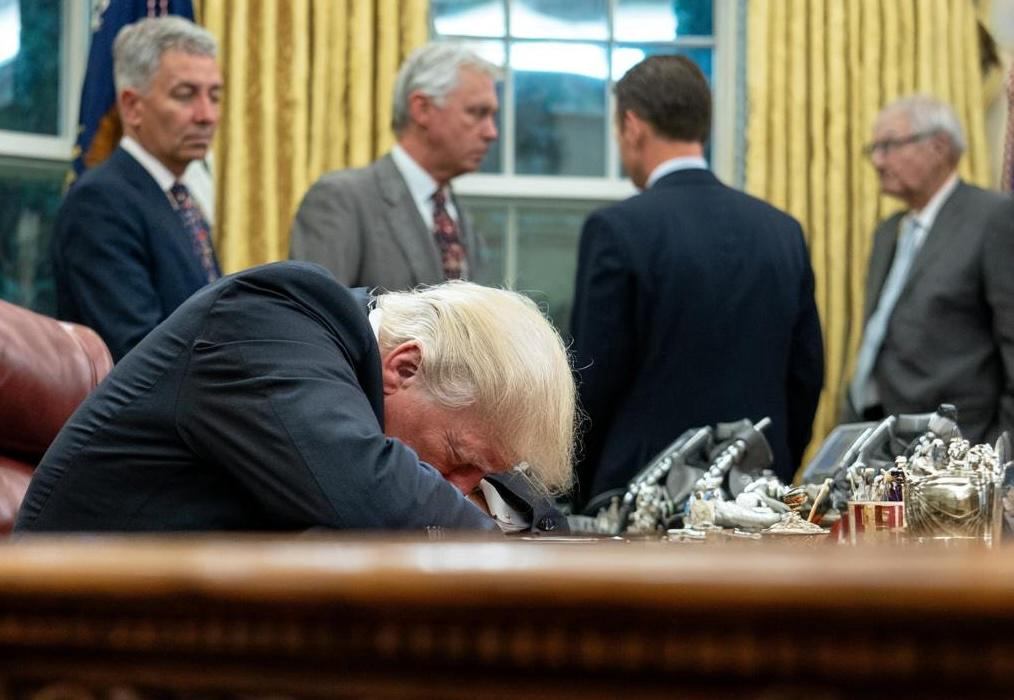
A physician’s public claim that President Donald Trump may have suffered a stroke has collided with a fresh round of scrutiny over the 80-year-old president’s stamina following what critics called a listless swing through the West Coast this week. Dr. Bruce Davidson, a board-certified internal medicine and pulmonary physician and professor at Washington State University’s Elson S. Floyd College of Medicine, has argued that footage of the president points to a stroke — most likely on the left side of the brain and probably sometime in 2025.
Davidson, who has not personally examined Trump, built his theory entirely from publicly available video and disclosed medical details. He pointed to a shuffling gait, garbled speech that later improved, right-sided weakness and episodes of daytime sleepiness. He also flagged Trump’s disclosed 325 mg daily aspirin dose, noting that such a regimen is typically recommended to prevent a recurrent stroke rather than as a first-line preventive measure. He first laid out the argument on the podcasts “The Court of History” and “The Daily Beast Podcast,” as well as in an opinion piece.
The White House has flatly rejected the stroke theory, and Trump’s own medical team has not confirmed any such event.
Newsom Seizes on West Coast Trip
The debate over the president’s condition intensified after California Gov. Gavin Newsom, a longtime Democratic antagonist, used a brief Los Angeles visit to needle Trump over his health. In an X post Wednesday morning, Newsom’s press office attached a 14-second clip of the president fielding questions from reporters on the tarmac.
Newsom’s office said the trip was “a total snoozer,” adding that Trump displayed “Very low energy. No speech. He could barely take a question on the tarmac.”
The clip showed Trump gingerly walking away from the press as one reporter raised the name of Max Miller, the embattled MAGA representative from Ohio who is battling calls to drop out amid accusations from his former spouse of domestic violence and child abuse. After hearing Miller’s name, Trump briefly pivoted, shrugged, said he hoped Miller would stay and work it out, then walked off.
On Tuesday, Trump traveled west to attend a Republican National Committee fundraising event at his golf club in Rancho Palos Verdes. From there, he went to Nevada, where he promoted the administration’s tax relief initiatives at a rally at the Red Rock Casino, Resort & Spa.
Security Concerns Shadow the Visit
The trip was also marked by security scares. Days before Trump arrived at the Southern California course, police arrested an armed man who had been observed on foot at the Rancho Palos Verdes property carrying a magazine holding 16 rounds plus additional ammunition, according to the Los Angeles County Sheriff’s Department.
Separately, Marine One’s departure from the White House on Tuesday raised alarms when the aircraft carrying the president departed while commercial air traffic continued at a nearby airport, a scenario that runs counter to standard safety protocols. Both the White House and the Federal Aviation Administration (FAA) said Trump was never in danger.
A Recurring Question and a Sharp Denial
Questions about the president’s condition are not new. Trump has repeatedly faced scrutiny over his chronically bruised hands, swollen ankles, public bouts of drowsiness and occasional mental flubs. The White House has consistently insisted he is in good health, and it responded to Newsom’s latest jab with characteristic ferocity.
White House spokesperson Davis Ingle dismissed the governor as the worst and possibly the dumbest chief executive in the country, arguing that Trump’s sharpness, energy and accessibility stand in stark contrast to the previous administration. Ingle accused Democrats of having covered up former President Joe Biden’s mental and physical decline while now targeting Trump.
Davidson’s claims remain unverified by anyone with direct access to the president. As a diagnosis rendered from a distance, based on video clips and a publicly disclosed medication, his assessment carries obvious limitations, and no member of Trump’s medical team has corroborated it. Still, the combination of a physician’s stroke theory and a governor’s viral broadside has thrust the president’s fitness back to the center of political conversation.
For now, the competing narratives sit in stark opposition. One frames a president slowed by age and possible illness; the other portrays a vigorous leader whose critics, in the administration’s telling, are recycling a playbook they once used to shield a Democratic incumbent. What is not in dispute is that the health of the oldest sitting president in American history has become an inescapable subplot of his second term — one that a low-energy tarmac exchange and a doctor’s unconfirmed hypothesis have only amplified.
