
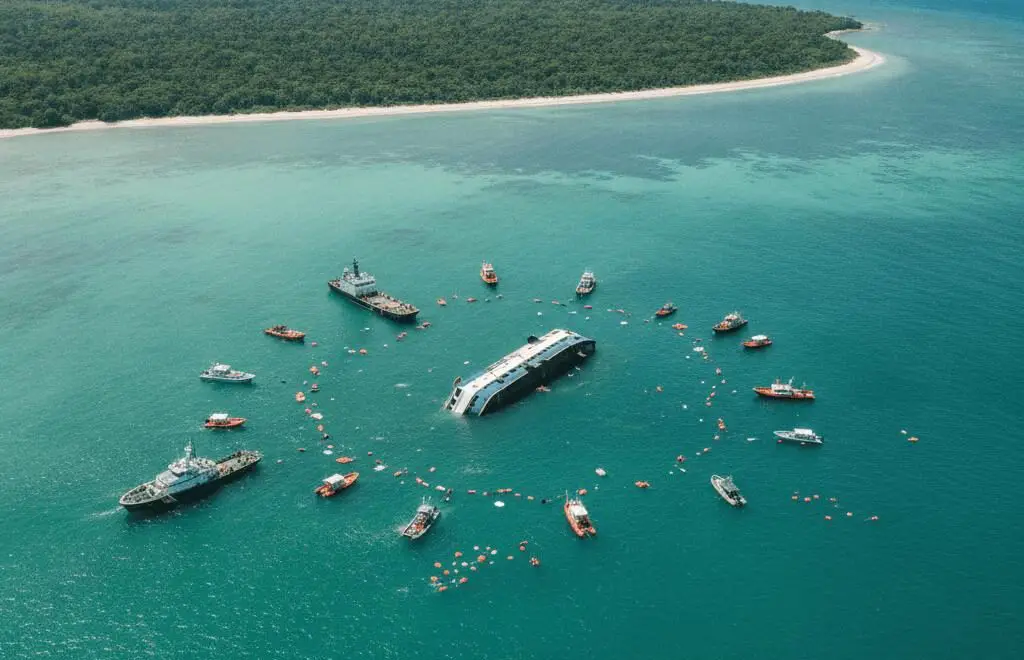
A ferry disaster on Zimbabwe’s Lake Kariba has now claimed 84 lives, with 18 of the dead being small children—most aged 10 or younger and the youngest just 1 year old—according to updated reports following the vessel’s capsizing on Aug. 11, 2026.
President Emmerson Mnangagwa has declared the incident a national disaster, bringing it under the Civil Protection Unit, while Transport and Infrastructural Development Minister Advocate Felix Mhona visited the accident scene alongside Mashonaland West Provincial Affairs Minister Marian Chombo.
The government-operated ferry carried 114 adults plus five crew when it overturned—well beyond the vessel’s stated 90-person capacity. Rescue operations have recovered 67 survivors from the water, down from initial reports of 77, leaving a significant number of fates unresolved as search teams continue their work.
Investigations Point to Environmental and Operational Causes
Early investigations have ruled out structural failure, finding the vessel’s hull intact. Authorities have instead turned their attention to operational and environmental factors, including powerful winds known as the “Binga Wave” that are common on the lake.
Video posted by Mutsa Murombedzi, a local member of Parliament, captured the ferry’s departure and revealed onlookers voicing fears about whether the aging vessel could withstand the day’s strong waves. Those concerns proved tragically prescient, though officials have not confirmed at what point during the roughly five-hour voyage the ferry capsized or what specific conditions caused it.
State broadcaster ZBC aired footage of speedboats rushing toward what appeared to be the overturned vessel while a helicopter circled above. An underwater search-and-rescue team was deployed to search the lake’s deep waters for additional victims and survivors.
Manifest Gaps May Hide True Death Count
The disaster management agency’s official passenger count included only paying adults, meaning that young children who did not require tickets may have been aboard without any record. That gap means the actual number of people aboard when the vessel went down remains uncertain, and the final death toll could climb as the search continues.
ZBC reported children among the dead, though authorities initially did not release a breakdown of victim ages. Police posted the earlier death toll on X and announced that bodies had been pulled from the lake, but provided no figures on how many remained injured or missing. By Aug. 12, the count had risen sharply as more victims were found.
Lifeline for Remote Communities
Murombedzi said residents of remote villages depend on the ferry for the approximately five-hour crossing to Kariba town. The vessel, run by a government agency, serves as a crucial transport link for communities along the shoreline that have limited alternatives for reaching essential services and businesses that would be hard to access by road.
Lake Kariba ranks as the world’s largest artificial reservoir measured by capacity, extending over 200 kilometers—approximately 124 miles—from end to end and spanning 40 kilometers, around 25 miles, at its broadest sections. It was formed in the late 1950s and early 1960s when a dam wall was built across the Zambezi River, submerging the valley that lay upstream.
The body of water spans both Zimbabwe and Zambia, with the international border passing down the middle. For the Zimbabwean communities along its shores, ferry passage to the town of Kariba represents not a recreational journey but a primary means of connecting to essential resources.
