
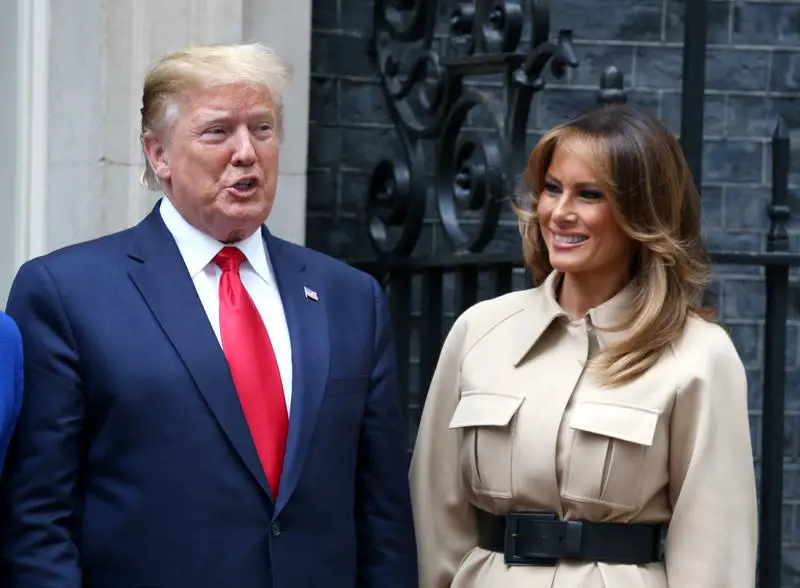
President Donald Trump’s off-the-cuff remark at the Congressional Picnic on the White House South Lawn on May 19 has sparked fresh scrutiny of his public treatment of first lady Melania Trump, after he joked about needing to “get rid of” her because there’s “only room” for one star in the family.
The 79-year-old president began by praising his 56-year-old wife’s recent accomplishments, telling picnic attendees, “We’re truly blessed to have such a first lady. She’s been so popular.” He continued, “She did a movie, it became number one. She then went to streaming, it became number one.” But the compliment took an unexpected turn: “And I say there’s only room, remember this, for one star in a family, so I better get rid of that.” He then added, “That’s not, that’s not so good.”
The first lady stood beside her husband smiling and laughing continuously as he delivered the line, which he apparently intended as humor.
The Documentary Hovering Over the Joke
Trump was referring to the Amazon-MGM documentary “Melania,” which debuted worldwide on January 30. The film became the largest opening for any non-musical documentary in over a decade, despite facing withering criticism. Directed by Brett Ratner, the disgraced Hollywood filmmaker, the project was review-bombed online before its release and drew public statements from crew members who admitted hoping it would fail. Critics also suggested that ticket sales may have been inflated through forced bulk buying.
This month, Amazon founder Jeff Bezos faced questions about whether the multimillion-dollar documentary constituted a “bribe” to the Trump administration. Bezos denied that the project was intended for “buying influence,” calling that characterization “just not correct.” However, he acknowledged, “I can see why people say this.”
Colbert Sharpens the Knife
Two nights later, on May 21, Stephen Colbert dissected the moment during his CBS late-night program. The 62-year-old host didn’t treat the comment as harmless banter.
“It was a pretty weird thing to say to your wife, but at least he’s finally got a use for that greeting card,” Colbert said, before presenting a mock message: “Roses are red. I love a gardenia. Time for you to go back to Slovenia.”
The joke referenced the first lady’s Slovenian heritage and played into longstanding observations about the couple’s public interactions and apparent emotional distance.
A First Lady Increasingly Off Script
The picnic comment comes amid a period when Melania Trump has demonstrated a notable independence from White House messaging. On April 9, she appeared before cameras at the White House to categorically deny any connection to the late financier Jeffrey Epstein or his convicted accomplice Ghislaine Maxwell, calling out the “lies linking me to the disgraceful Jeffrey Epstein.”
During that same appearance, she urged Congress to convene public hearings where Epstein’s victims could testify on Capitol Hill. The call directly contradicted West Wing strategy, where the president and his senior staff have worked to minimize attention to the Epstein issue and assert that the nation is prepared to move forward.
The Republican-led House Oversight Committee deposed Bill Clinton and Hillary Clinton in February regarding their knowledge of Epstein and Maxwell. The Trumps have not been questioned. Epstein pleaded guilty in Florida in 2008 to state charges of soliciting prostitution from a minor and served 13 months in jail under a controversial plea agreement. He was arrested on federal sex-trafficking charges in 2019 and was found dead by suicide in his cell while awaiting trial. Maxwell is serving a 20-year federal prison sentence.
The first lady’s public statement reportedly upset portions of the West Wing. A handful of officials were “stunned by the timing” of her remarks. “One official said there was disagreement among those close to Melania Trump as to whether or not to go through with the remarks, given that the story had died down,” one source said, while noting that the first lady “wanted to go on the record with a firm denial.” According to the same reporting, the president knew his wife intended to speak.
Against this background, Trump’s comment about needing to “get rid of” his wife appears less like an isolated joke and more like another episode in a marriage being chronicled, frequently uncomfortably, before the public eye. Whether the remark was spontaneous ribbing, an awkward attempt at flattery, or something altogether different, it accomplished what many of the president’s statements about Melania Trump manage to achieve: it spread far beyond what he probably anticipated, reaching audiences whose amusement was considerably less generous than hers.
