
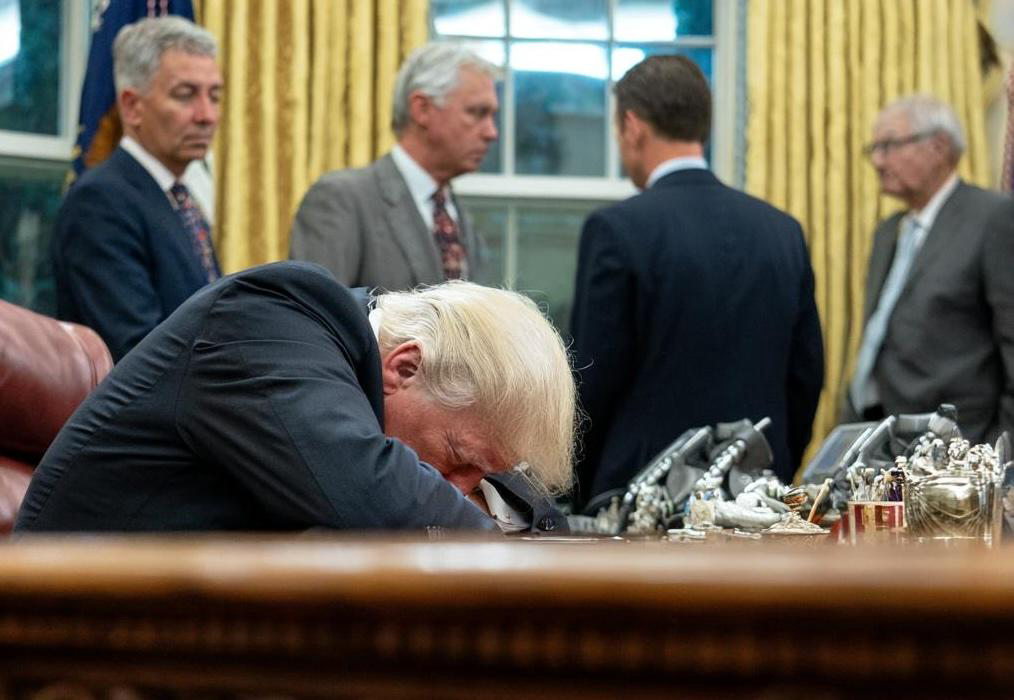
White House Press Secretary Karoline Leavitt dismissed claims that President Donald Trump suffered a stroke, calling the allegations “categorically false and slanderous” as two separate medical professionals have publicly suggested the 79-year-old commander in chief experienced a serious neurological event.
The controversy intensified when Adam James, a physical therapist with a doctorate and 14 years of geriatric experience who posts as @epistemiccrisis, published a detailed Instagram video on June 5 analyzing Trump’s June 4, 2026, Oval Office appearance at a press briefing on “clean coal.”
James walked viewers through what he identified as clinical indicators of a left-sided brain stroke, including a leaning posture, slurred speech and difficulty finding simple words, a jaw drifting rightward, and what he described as a right-sided facial droop. In the post, James claimed the president had suffered a stroke and the administration was attempting recovery before his public reappearance, and the analysis received broad coverage on June 7.
A Week-Long Absence From Public View
Trump had been largely absent from public view from May 27 to June 3, roughly seven days that fueled speculation across social media about why the famously visible president had gone dark. His re-emergence on June 4 did little to quiet the noise. During the briefing, Trump introduced Interior Secretary Doug Burgum and Environmental Protection Agency Administrator Lee Zeldin, then reclined in his chair and appeared to close his eyes as the two officials spoke. Online observers said he looked to be nodding off. Trump has long insisted he is merely resting his eyes.
James labeled one stretch of Trump’s remarks as showing expressive aphasia, distinguishing it from phonemic paraphasia, which he tied to dementia rather than stroke. He also pointed to Trump’s posture, saying stroke patients often cannot maintain an upright trunk when fatigued and lean to one side. He suggested the president was slipping in and out of consciousness during the briefing.
Snopes published a fact-check on June 7 finding no credible evidence that Trump had suffered a stroke, while documenting how rapidly the claim had spread online.
Professor Points to Late 2025 Incident
The new wave of speculation has also revived attention on Professor Bruce Davidson of Washington State University’s Elson S. Floyd College of Medicine, whose own stroke theory drew national attention on January 15, 2026. In a podcast appearance on “The Court of History” with biographer Sidney Blumenthal and Princeton historian Sean Wilentz, Davidson argued the president had suffered a stroke in late 2025 and concealed it.
Davidson suggested the stroke occurred six months or more before his podcast appearance, earlier in 2025, pointing to videos of Trump shuffling his feet, cradling his right hand in his left, and garbling words. He described “marked episodes of excessive daytime sleepiness,” known medically as hypersomnolence, as common among stroke patients.
Davidson also said footage of Trump gingerly descending the steps of Air Force One while gripping the banister with his left hand — despite being right-handed — was consistent with a left-brain stroke. If his read is correct, he added, the president “looks like he’s had significant recovery.”
Official Record Shows Excellent Health
Trump’s May 26 annual physical at Walter Reed National Military Medical Center, conducted by his physician Navy Capt. Dr. Sean Barbabella, was declared to show “excellent health,” though unverified rumors that the visit returned concerning results have circulated alongside the stroke speculation. Leavitt has rejected the claims forcefully, accusing critics and outlets of recycling the playbook used during former President Joe Biden’s tenure. She has cited Trump’s “relentless work ethic, unmatched energy, and historic accessibility” and argued that pushing such narratives is why public trust in the media has continued to slide.
Compression Socks and Aspirin Regimen
Trump has acknowledged some health issues without conceding the broader narrative. In a Wall Street Journal interview published in January 2026, he said he had briefly worn compression socks to manage leg swelling tied to chronic venous insufficiency — a condition the White House first disclosed in July 2025 — and admitted to taking more aspirin than his doctors recommend for “cardiac prevention.” The administration has long attributed the visible bruising on his hands, often dabbed with makeup, to that aspirin regimen combined with frequent handshakes.
Concerns spiked again in 2025 when Trump appeared at a September 11 terror attacks anniversary event with his face seeming to droop on one side. No diagnosis was confirmed then, and none has been confirmed now. As of June 9, 2026, the official record holds that the president is healthy — even as the videos, the speculation, and the experts willing to weigh in continue to multiply.
