
In a new interview tied to his History Channel docuseries, Tom Hanks is speaking plainly about what he sees as the most dangerous force in American life — and it’s not extremism or rage. It’s indifference.
“The best petri dish for tyranny is indifference, and we have a choice every single day to do something or not based on what we think is right,” he said.
The remarks came during a conversation with Time, published last week, that was highlighted by HuffPost on Monday. The Oscar winner argued that the country faces a test that mirrors some of the most troubling periods in its past, and that apathy creates the conditions for authoritarianism to flourish.
Lessons From Internment Camps and the Streets
Hanks pointed to the internment of Japanese Americans during World War II as a stark example of what happens when a population looks the other way. The country, he said, has a habit of rewriting its own role after the damage is done — insisting it didn’t know what was happening, even when the evidence was everywhere.
He drew a parallel to the present day, comparing the claim that Americans didn’t see neighbors being rounded up and imprisoned to the claim that people don’t notice homelessness on their own streets. Both, he argued, are plainly visible and demand a response. The country, he warned, risks repeating history if it chooses complicity over action.
The comments, widely circulated internationally, come at a moment when Hanks himself has become a political target. President Trump has publicly attacked the actor as “destructive” and “WOKE.” Hanks has not responded in kind, choosing instead to focus on history rather than partisan feuds.
What Moral Courage Looks Like Now
When asked what moral courage means today, Hanks offered a framework rather than a single answer. Civic engagement, he said, doesn’t have to look the same for everyone — but it has to exist.
“Now, for some of us, it’s showing up and raising our fist and saying, ‘not on my watch,'” Hanks explained. “For others, it’s giving money to those who fight the good fight. For many others of us, it just comes down to not ignoring what’s going on and continuing to tell the stories that matter.”
Storytellers like Hanks have built their careers around this final form of engagement. From “Saving Private Ryan” to “Band of Brothers” to “The Pacific,” he has returned again and again to World War II, using the past as a lens to examine the present. His new project, “World War II with Tom Hanks,” is the latest chapter in that work.
A Country Still Becoming
The United States will mark its 250th anniversary of founding on July 4, 2026, a milestone Hanks described not as a triumph but as a checkpoint in an ongoing struggle. He characterized the anniversary as marking “the beginning of the two-steps-forward, one-step-back process of making our nation a more perfect union.”
“We will never be a perfect union but we’ve had 250 years to figure out how we actually get closer to that,” he said.
Perfection, he made clear, is not the standard. Progress is.
The New Docuseries and a Larger Question
Hanks’ interview was conducted to promote “World War II with Tom Hanks,” a 20-episode series created in partnership with the National WWII Museum in New Orleans. New episodes premiere Mondays on the History Channel, with the first three available to stream now.
The actor, whose fascination with the era has shaped much of his creative output, suggested this time around that the project is less about honoring what he has called the greatest generation and more about confronting a harder question: what that generation would think of the country now.
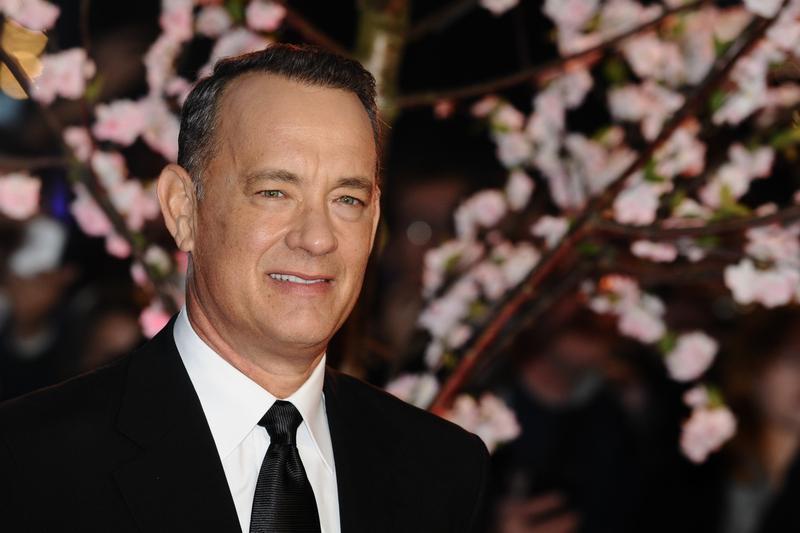
The actor, photographed at the 2024 premiere of his film “Here,” was last in the cultural spotlight for that Robert Zemeckis-directed drama. His shift toward documentary work feels deliberate — less about portraying history than challenging audiences to reckon with it.
For Hanks, the stakes are personal. He framed civic participation as something no one can escape, whether through protest, financial support, or simply refusing to ignore what’s in front of them.
As coverage of the interview noted, the warning carries unusual weight coming from one of the country’s most universally liked public figures. When Hanks sounds the alarm about tyranny, people pay attention. Whether they respond with more than attention, he suggested, remains to be seen.
