
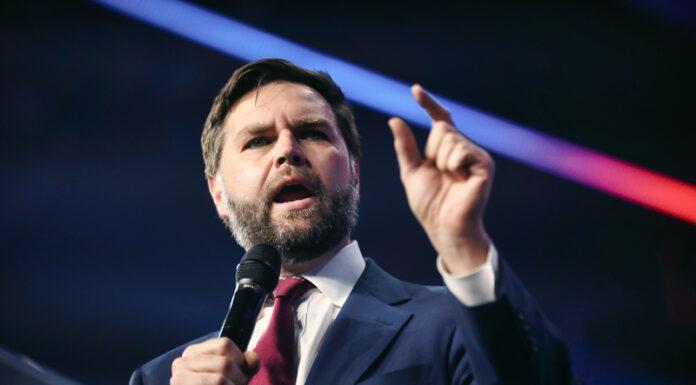
A Fox News appearance by Vice President JD Vance on Monday night, April 13, 2026, has sparked widespread criticism after he appeared to inadvertently admit the Trump administration is engaging in the same conduct it condemns Iran for pursuing.
The controversy centers on Vance’s characterization of naval blockades during his interview with correspondent Bret Baier. While defending the U.S. blockade of Iranian ports as a proportional response to Iran’s closure of the Strait of Hormuz, Vance labeled Iran’s actions “economic terrorism” while describing the American response in nearly identical terms.
“As the president of the United States showed, two can play at that game. And if the Iranians are going to try to engage in economic terrorism, we’re going to abide by a simple principle that no Iranian ships are getting out either. We know that’s a big deal to them,” Vance told Baier.
Critics quickly pounced on what they labeled a “Kinsley gaffe” — journalist Michael Kinsley’s term for when a politician accidentally tells the truth. By framing both blockades through the same lens, Vance appeared to concede that the United States was engaged in the very behavior it was condemning.
The video circulated broadly on X and other platforms within hours of the broadcast, with a Threads post by HuffPost pointing out the apparent contradiction gaining rapid traction on social media.
The rhetorical stumble comes as Vance faces multiple setbacks. Just days before the interview, he led a U.S. delegation to Pakistan for talks with Iranian officials aimed at negotiating a permanent ceasefire. Those meetings in Islamabad ended without a deal after 21 hours of negotiations, and U.S. officials were discussing details for a potential second round of in-person meetings as the administration scrambled to salvage diplomatic progress.
Earlier in the week, Vance had traveled to Hungary to campaign for Viktor Orbán, a close Trump ally and ally of Russian President Vladimir Putin, only to see his preferred candidate lose to opponent Péter Magyar.
During the same Fox News segment, Vance also addressed President Trump’s ongoing criticism of Pope Leo XIV, who has emerged as a vocal critic of the U.S. war in Iran. The vice president downplayed the president’s attacks on the pontiff and urged the Vatican to stay out of policy matters.
“I certainly think that, in some cases, it would be best for the Vatican to stick to matters of morality … and let the president of the United States stick to dictating American public policy,” Vance told Baier, adding that the pope should focus on “what’s going on in the Catholic Church.”
That response has drawn its own round of criticism from religious leaders and foreign policy analysts who say the administration is trying to silence international voices of dissent.
But the “economic terrorism” remark has generated the most sustained attention. The exchange fits neatly into Kinsley’s original formulation — “a gaffe is when a politician tells the truth — some obvious truth he isn’t supposed to say.”
The administration has characterized its blockade as defensive and proportional, but Vance’s formulation on Fox News suggested equivalence rather than distinction. By using the same framework — “two can play at that game” — he undermined the argument that the U.S. response occupies different moral or strategic territory.
The unforced error highlights the rhetorical tightrope the administration walks as it tries to justify aggressive economic measures against Iran while maintaining the moral high ground. Critics argue the remark reveals the administration’s double standard: condemning adversaries for actions the U.S. itself mirrors.
The incident has energized critics of Trump’s Iran policy, who have long argued it lacks a coherent strategy. With ceasefire negotiations stalled and domestic political pressure mounting, the vice president’s verbal stumble adds another complication to an already fraught situation.
Political observers note that Vance has struggled with public messaging throughout his tenure, often finding himself caught between defending the president’s positions and managing their political fallout. The interview offered a fresh example of those tensions.
