
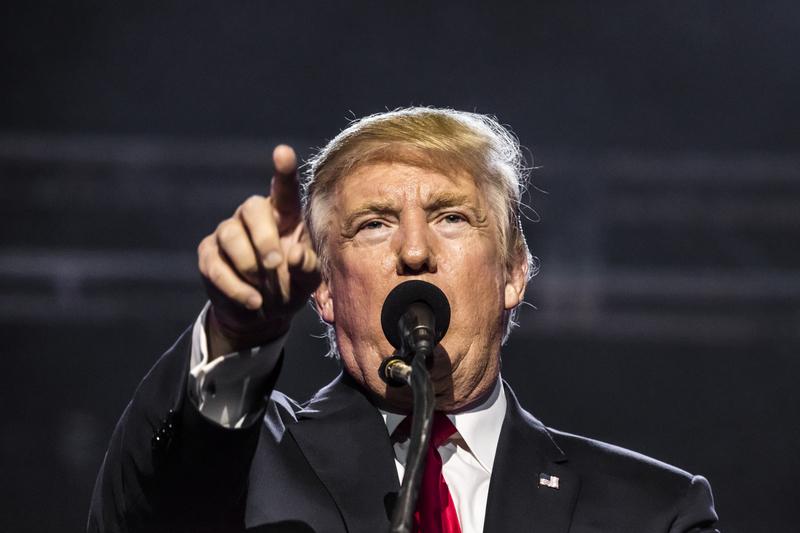
President Donald Trump initiated a significant military offensive against Iran without securing congressional approval beforehand, declaring on Feb. 28 that American and Israeli forces had commenced strikes within what the White House termed “Operation Epic Fury”—a military initiative that detractors claim intentionally circumvents the 1973 War Powers Resolution mandating congressional notification and authorization.
The offensive commenced at roughly 1:15 a.m. with a barrage of cruise missiles and air-launched weaponry directed at Iranian military command, missile systems, and nuclear sites. An Israeli attack during the initial stage resulted in the death of Iranian Supreme Leader Ali Khamenei. By late March, U.S. Central Command (CENTCOM) documented 303 American military personnel wounded and 13 fatalities during the campaign, while the Pentagon has directed the 82nd Airborne Division to move to the Middle East, with CENTCOM verifying over 50,000 U.S. forces currently deployed in the region as ground operations continue to be evaluated. Trump has defended restricting congressional participation by asserting lawmakers “have a tendency to leak.”
On March 28, Yemen’s Houthis officially joined the hostilities, initiating their first ballistic missile assaults on southern Israel, further expanding the regional conflict. The combat has driven oil prices beyond $114 per barrel — the peak level since the COVID-19 pandemic.
The Iran campaign represents Trump’s second substantial military endeavor in three months, executed without advance congressional authorization. On January 3, U.S. special forces apprehended Venezuelan President Nicolás Maduro in a nighttime assault on his residence in Caracas, with congressional leaders not briefed until after the mission commenced. That mission triggered intense controversy when the House narrowly rejected a War Powers Resolution that would have compelled an end to military actions in Venezuela.
Former House Speaker Nancy Pelosi criticized Trump’s practice of unilateral military intervention. “President Trump has made no secret of his intentions to effectively abolish Congress, and that pattern continues today with his flagrant disregard for the Article One war powers of Congress, which is essential to our constitutional system of checks and balances,” Pelosi said in response to the Venezuela operation.
The War Powers Resolution requires presidents to inform Congress within 48 hours of committing troops into hostilities and secure congressional consent or remove forces within 60 days. Enacted in 1973 over President Nixon’s veto after the Vietnam War, the statute was crafted to prevent precisely the type of unilateral executive military intervention Trump has now executed twice in quick sequence.
The administration’s legal rationale depends on differentiating between declaring “war” and undertaking “military operations”—a linguistic contention opponents reject as constitutional sophistry. While Trump has referenced the 2001 Authorization for Use of Military Force in previous operations, that authorization explicitly addresses terrorist organizations accountable for the September 11 attacks, not nation-states like Iran.
Both chambers later voted down measures that would have compelled an end to the campaign, 53–47 in the Senate and 219–212 in the House, essentially granting Trump a congressional authorization to proceed.
Sen. Bernie Sanders called for urgent action to restore congressional power. On February 28, Sanders released a statement proclaiming, “It is the Congress that declares war, not a president acting unilaterally. The Senate must reconvene immediately and vote on a pending War Powers Resolution.”
The Venezuela mission revealed the administration’s readiness to proceed without congressional consultation. Trump administration representatives informed senators there were no U.S. forces on the ground in Venezuela and pledged to secure congressional consent before a major operation, declarations made just days before special forces seized Maduro. Trump subsequently declared the U.S. would “run the country until we can do a safe, proper and judicious transition,” while declining to exclude additional troop deployments.
Republican leadership has predominantly backed Trump’s broad reading of executive war authority, though divisions have surfaced. Reps. Thomas Massie of Kentucky and Don Bacon of Nebraska defected to vote with Democrats on the Venezuela measure. Bacon referenced a fake image Trump posted showing the president planting an American flag on Greenland as one reason for his vote.
Operation Epic Fury arrives amid wider worries about Trump’s military policy strategy, which has involved threatening Denmark over Greenland and executing operations without customary intelligence committee briefings. When challenged on his choice to bypass Congress from operational planning, Trump justified the secrecy by highlighting concerns about leaks, emphasizing operational security over constitutional mandates for legislative oversight.
Democratic leaders caution that Trump’s approach constitutes a fundamental danger to constitutional checks and balances. Rep. Gregory Meeks, the top Democrat on the House Foreign Affairs Committee, contended during floor debate that Trump “is reducing the United States to a regional bully with fewer allies and more enemies.”
The political consequences of Trump’s approach became evident during the House vote on the Venezuela measure. Republican leadership maintained the vote open for more than 20 minutes while Rep. Wesley Hunt returned from Texas to deliver the deciding vote. Democrats yelled at the chair to close the vote, but the postponement enabled the 215-215 tie that blocked the measure. Vice President JD Vance likewise broke a Senate tie on a similar resolution, illustrating the narrow margins by which Trump’s unilateral power withstands congressional challenge.
With 290 Americans wounded in Operation Epic Fury and no definite conclusion for Iranian operations, pressure intensifies on Congress to compel a constitutional showdown over war powers. Whether lawmakers can gather the political determination to restrain executive military power remains uncertain, but Trump’s choice to organize operations to restrict congressional participation has clarified the stakes of the debate.
