
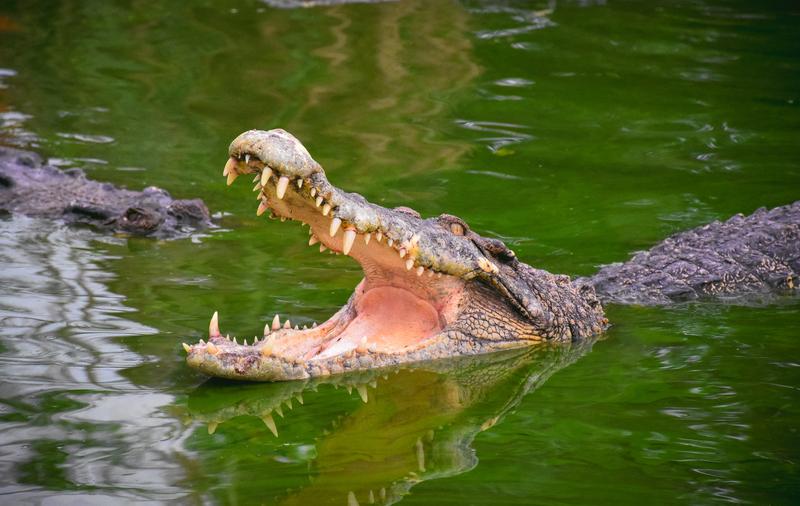
A crocodile claimed the life of a 13-year-old boy in Indonesia after he waded into a river to fetch a soccer ball that had gone into the water while he was playing an evening match with his companions.
Muhammad Abidzhar, called Habi by his peers, went into the water close to the Kutai Lama harbor pier located in Anggana District, Kutai Kartanegara Regency, on March 29, 2026, at approximately 5:30 p.m. local time. The youngsters had been swimming and tossing a ball around when it ended up in the crocodile-inhabited waterway. Abidzhar offered to get it, a choice that proved fatal.
His terrified companions heard only one scream before the boy disappeared below the dark surface, dragged down by a predator that had been lurking from beneath. The youngsters ran to their village to notify officials.
Meiry Sulindra, chief of the Anggana Fire and Rescue Post, verified his crew got the alert shortly before maghrib prayers. “The incident happened around 5:30 p.m.,” Sulindra told reporters. Staff from the Anggana Fire and Rescue division right away began a search mission utilizing rubber boats to comb the zone surrounding the harbor pier.
The operation went on throughout the night and into the next day, complicated by powerful currents and changing tides. Searchers observed several crocodiles emerging during the mission, a stark indication of how perilous these waters had turned.
Abidzhar’s remains were found around 8 p.m. on Monday, March 30, floating roughly 1.6 kilometers downstream from his entry point. Recovery teams in the middle of the river retrieved his body and brought it straight to his family residence.
An inspection showed several injuries matching a crocodile assault, including trauma to the boy’s jaw and back.
The event underscores the increasing threat of human-crocodile encounters in East Kalimantan and throughout Indonesia. The archipelago hosts four recognized crocodilian species, with the saltwater crocodile (Crocodylus porosus) accountable for the overwhelming majority of assaults on humans. These apex predators can surpass six meters in length and are highly territorial, flourishing in the region’s rivers, mangrove forests, and coastal waters.
Indonesia tops the world in crocodile attacks by an overwhelming margin. Between 2015 and 2024, 1,167 people in Indonesia were attacked by crocodiles, causing 556 deaths, far exceeding any other nation, according to the CrocAttack database. East Kalimantan by itself documented 102 attacks with 54 deaths during that timeframe, ranking it among the most hazardous provinces in the country.
Conservationists identify multiple factors bringing crocodiles nearer to human communities. Overfishing has diminished the predators’ natural prey, compelling them to hunt in zones they previously stayed away from. Habitat destruction from the transformation of coastal regions into farmland has additionally shrunk their territory. Palm oil plantation canals and other waterway alterations have generated new crocodile habitats in inhabited zones.
Extensive tin mining activities—especially in provinces like Bangka-Belitung—have also driven villagers to intrude on crocodile habitats, establishing dangerous closeness between people and the apex predators. Numerous residents in developing regions still depend on rivers for bathing, fishing, and everyday tasks, heightening their exposure to attacks.
This catastrophe represents the most recent in a string of deadly crocodile attacks throughout Indonesia in recent months. In March 2025, 10-year-old Fikri Qurniawansyah was killed while riding a makeshift canoe with friends in Riau province. The boy put his hand in the water before a crocodile seized his arm and dragged him under the surface.
Search crews found and killed a crocodile thought to be responsible for that assault, but when they opened its stomach, they discovered it was empty. Fikri’s body was ultimately found floating face-down in the river by a local farmer. A medical examination showed multiple bruises consistent with a “death roll”—the violent spinning technique crocodiles use to subdue prey.
The rate of such events has generated worry among local authorities and wildlife experts. Crocodile populations in Indonesia have recovered since large-scale hunting was prohibited in the late 1990s, but the absence of warning systems and protective measures presents a substantial challenge in reducing conflicts.
Attacks are particularly concentrated in East Kalimantan on Borneo and Bangka-Belitung off Sumatra. The frequently illegal tin mining in Bangka-Belitung has produced many artificial bodies of water that function as perfect habitat for crocodiles seeking new hunting grounds.
The waterways surrounding Kutai Kartanegara Regency, where Abidzhar perished, function as essential habitat for these predators while concurrently serving as a lifeline for local communities who rely on them for transportation, fishing, and daily activities. This intersection generates unavoidable conflict between humans and one of nature’s most powerful predators.
Local officials have called on residents to use extreme caution near waterways, especially during dawn and dusk when crocodiles are most active. Authorities have requested the public to report any crocodile sightings right away so preventive action can be taken.
Abidzhar’s death highlights the tragic price of Indonesia’s continuing human-wildlife conflict and the pressing need for coordinated efforts to protect both human communities and the crocodile populations that share their environment.
