
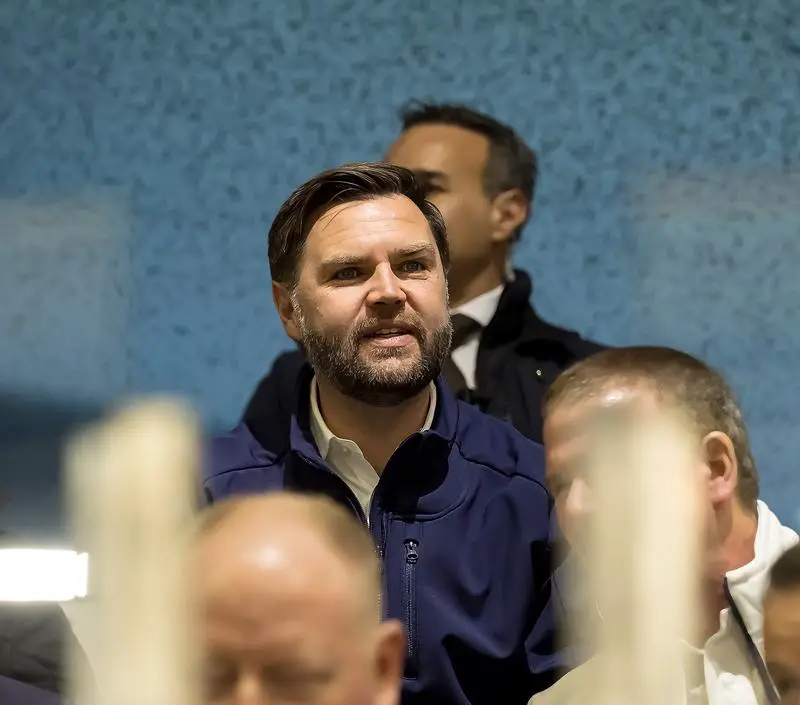
Vice President JD Vance is embroiled in a major White House dispute after new accounts link him to the departure of a senior national security official and a contentious internal clash over the administration’s handling of the Iran conflict.
The 41-year-old vice president, who rose from poverty in Middletown, Ohio, to hold the nation’s second-highest office, is under scrutiny for his reported participation in a heated confrontation about war aims and Iran strategy.
Per multiple reports, Vance met at the White House on March 16, 2026 with National Counterterrorism Center Director Joe Kent and Director of National Intelligence Tulsi Gabbard — the day before Kent announced he would resign. Kent became the first senior Trump administration official to step down over the Iran war, posting a public letter saying he could not “in good conscience support the ongoing war in Iran” and asserting that “Iran posed no imminent threat to our nation.” In later remarks, Kent said Vance and Gabbard had been “put in a tough spot” by Trump’s decision. He added, “And that’s why I wanted to give them a heads up.”
The disagreement revolves around different ideas about the Iran campaign. President Donald Trump ordered military strikes against Iran on Feb. 28, 2026, labeled by the administration as “Operation Epic Fury.” Trump initially pushed for regime change, urging Iranians to “take back your government” in social media posts after strikes. Vance later appeared to minimize regime change as a central aim during a Fox News interview, creating visible distance between his remarks and earlier White House messaging.
When reporters asked about differences between him and Vance, Trump acknowledged friction, saying Vance had been “maybe less enthusiastic” about striking Iran while adding that “we get along very well on this.”
Vance summarized what he described as Trump’s four core goals for the Iran campaign: neutralizing Iran’s missile capabilities, degrading its navy, stopping the acquisition of nuclear weapons, and cutting off funds for terrorism. He argued these aims mark a contrast with past U.S. military efforts that lacked clear goals.
On Fox News, Vance defended the administration’s plan: “There’s just no way that Donald Trump is going to allow this country to get into a multi-year conflict with no clear end in sight and no clear objective.”
Speaking at a campaign-style event in Auburn Hills, Michigan, on March 19, Vance addressed Kent’s resignation directly for the first time, saying “nobody likes war” and supporting Kent’s choice: “Whatever your view is, when the president of the United States makes a decision, it’s your job to make that decision as effective and successful as possible. If you are on the team and you can’t help implement the decisions of his administration, then it’s a good thing for you to resign.”
The controversy unfolds as Vance seeks to define his role in an administration where tech mogul Elon Musk often draws more attention than the vice president. Vance’s longstanding anti-interventionist reputation — shaped by years opposing “regime change wars” — clashes with his current defense of military action against Iran.
Vance drew international attention in February 2025 when a televised Oval Office meeting with Ukrainian President Volodymyr Zelenskyy turned into a sharp public exchange. Vance accused Zelenskyy of being “disrespectful” for challenging the administration in front of the press, telling him: “I think it’s disrespectful for you to come into the Oval Office to try to litigate this in front of the American media.” Outlets called the confrontation an unprecedented public quarrel between U.S. officials and a foreign leader.
Reports say Vance, Gabbard, and Kent — each known for opposing foreign intervention — have been unusually silent about the Iran campaign. After Kent presented his resignation letter to Vance, a White House official said the vice president “encouraged him to be respectful to POTUS” and recommended he consult the White House chief of staff before finalizing his decision.
Vance’s path from Marine Corps veteran to vice president has involved sharp changes. After finishing high school in 2003, he served four years in the Marines as a combat correspondent, including a six-month 2005 deployment to Iraq in a public affairs capacity. He studied at Yale Law School, wrote the bestselling memoir “Hillbilly Elegy” in 2016, won election to the U.S. Senate in 2022, and was chosen as Trump’s running mate in 2024.
The timing is sensitive for Vance, viewed as an early favorite for the 2028 presidential contest. Trump, 79, will be constitutionally barred from another term, and the fate of his predecessor Mike Pence — whose career suffered after refusing to overturn the 2020 election results — serves as a warning as Vance seeks to keep Trump’s support while building his own political brand.
Once a harsh critic who called Trump “reprehensible” and an “idiot” in 2016 before becoming a staunch MAGA supporter, Vance now faces the task of balancing his duties as the president’s deputy with his own political ambitions amid a war he previously opposed that could shape his future.
