
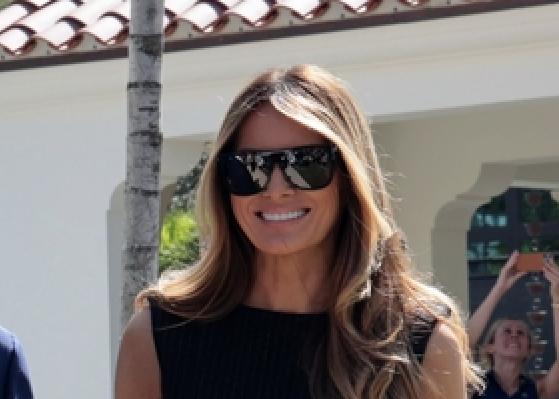
Over the weekend, Melania Trump revealed the opulent details of a private screening of her new documentary at the White House. She shared a video on Sunday, January 25, illustrating the transformation of the White House East Room into a theater for this prestigious event.
The First Lady entertained around 70 guests on Saturday evening, January 24, for a private viewing of “Melania,” a documentary produced by Amazon at a cost of $75 million. The film, directed by Brett Ratner, covers the 20 days preceding President Donald Trump’s inauguration. This marked the first viewing of the full film by the president.
Upon arrival at the East Room on January 24, guests were greeted by a full military band performing “Melania’s Waltz.” The video shared by the first lady showcased moments from the elaborate event, including her entrance into the room alongside President Trump.
The event attracted a host of celebrities, including Queen Rania of Jordan, Apple CEO Tim Cook, Amazon CEO Andy Jassy, and former heavyweight boxing champion Mike Tyson. Tech industry leaders like Zoom CEO Eric Yuan, New York Stock Exchange CEO Lynn Martin, and AMD CEO Lisa Su were also in attendance. Notable guests Erika Kirk and Tony Robbins were spotted at the event, along with 19-year-old Barron Trump.
The attendees were gifted with souvenirs from the evening, such as popcorn boxes, framed collectible screening tickets, and cookies bearing the first lady’s name. The event’s grandeur showcased the high-profile nature of the event, which was organized after the White House Family Theater was demolished in October to accommodate a $400 million ballroom project.
The timing of the screening has been criticized by some. On the day of the event, Alex Pretti, a 37-year-old ICU nurse, was shot and killed by federal agents in Minneapolis, Minnesota. This incident led to immediate criticism of attendees who chose to partake in the celebrations amidst the unfolding tragedy.
Jenna Ellis, a former Trump lawyer, publicly expressed her concern about the decision to proceed with the screening. “I have deep respect for the first lady and have been honored to meet her. But this event should have been postponed,” Ellis wrote. “With Minneapolis unraveling and Americans demanding leadership, this feels disconnected from reality.”
Despite the controversy, the documentary proceeded with its planned release schedule. A premiere at the Kennedy Center occurred on Thursday, January 29, followed by the official release on Friday, January 30. Amazon invested $40 million in the documentary and set aside an additional $35 million for marketing initiatives, making the film available in about 2,000 U.S. theaters and 5,000 theaters in 27 countries worldwide.
However, industry projections suggest that the film may face difficulties at the box office. The documentary is estimated to generate between $1 and $5 million during its opening weekend, a modest amount considering the significant investment in production and marketing. Early reports suggest the film is expected to fare poorly at theaters.
President Trump endorsed the film on social media on Monday with a brief statement, a departure from his usual lengthy reviews of supported media. “Beautiful job by Melania,” Trump posted. “Everyone should see this incredible documentary.”
The production of a documentary at this scale is a departure from traditional first lady projects, which usually concentrate on public service initiatives or cultural preservation. The commercial aspect of this project, along with the substantial budget and widespread theatrical release, sets it apart from previous first lady media appearances.
The attendance of major corporate figures like the CEOs of Apple, Amazon, and other Fortune 500 companies at the screening underscores the intersection of politics, business, and entertainment that defines the Trump era. These relationships between the administration and corporate leadership continue to be a subject of interest for political observers and media analysts.
The global theatrical release strategy spanning 27 countries indicates Amazon’s confidence that international audiences will be interested in this behind-the-scenes look at American political tradition. However, the anticipated opening weekend figures suggest that the documentary, despite extensive marketing and high-profile promotion, faces a challenge to recover its high costs through theatrical exhibition alone.
Supporters argue that the scheduling conflict after the Minneapolis shooting was unforeseeable and that postponing the event would have disrupted carefully coordinated release plans involving thousands of theaters across multiple continents.
The documentary about First Lady Melania Trump was pulled from South African cinemas just before its planned international debut, with the distributor citing sensitivities around political context and timing.
On Wednesday, January 28, Filmfinity—the film’s South African distributor—confirmed that the documentary “Melania” would no longer open theatrically in the country. The film had already been booked by the nation’s two major cinema chains, Ster-Kinekor and Nu Metro, along with independent venues such as Cape Town’s Labia Theatre.
Thobashan Govindarajulu, Filmfinity’s head of sales and distribution, said the company chose not to move forward with the theatrical launch in light of recent developments. He declined to provide further details but stressed there had been no external pressure to pull the release.
The film had already cleared South Africa’s standard classification and regulatory procedures before being withdrawn. According to individuals familiar with internal discussions, the central concern was whether a documentary centered on someone closely linked to current political power could be presented as neutral entertainment without additional context.
Nu Metro confirmed on Thursday that Filmfinity had requested the film’s removal from its theaters. The decision cancels all planned screenings across South Africa’s major chains and independent cinemas.
The documentary remains available through other distribution avenues. Sources underscored that the withdrawal reflects a business choice by the distributor, not a regulatory action by South African officials.
Relations between President Trump and South Africa’s government have been tense. The president has falsely claimed that white South Africans are facing genocide and has invited members of the white Afrikaans community to relocate to the United States.
South Africa’s history with political messaging and propaganda shaped public perception of the release. Industry observers note that local audiences and institutions are particularly attuned to media touching on issues of power, representation, and historical memory.
In the UK, theater executives reported weak advance ticket sales for the documentary. Amazon, which acquired the film, has invested heavily in marketing ahead of its global release on Friday, January 30.
The South African withdrawal comes as the documentary faces questions in several markets. Concerns about how the film frames its subject and the broader issue of political influence in entertainment have drawn increasing scrutiny.
Filmfinity had initially proceeded with theatrical distribution after the documentary passed regulatory review. The decision to reverse course followed discussions among the distributor, cinema operators, and other stakeholders about how the film might be received in the current environment.
